A radio wave is an electromagnetic wave used to transmit wireless messages through the air, an unbounded medium. Radio frequency (RF) occupies approximately 20 kHz to 300 GHz within the electromagnetic spectrum. section 18.0 section 18.2.2
An antenna produces radio waves when alternating electric current creates fluctuating electric and magnetic fields. Amplitude indicates signal strength, while frequency measures oscillations per second and determines propagation behavior. section 18.5 section 18.2.1
Use these relationships when reasoning about wireless LAN behavior:
- Higher frequencies can support higher data rates and are typically less crowded, but obstacles absorb them more readily. section 18.2.1
- Lower frequencies generally penetrate obstacles better and cover greater distances, but usually provide lower rates and encounter more congestion. section 18.2.1
- 802.11 wireless LANs use the 2.4 GHz, 5 GHz, and 6 GHz bands; communicating devices must use the same channel. section 18.2.2
- Wireless signals weaken through free-space path loss and can be altered by absorption, reflection, refraction, diffraction, and scattering. section 18.5
- Signals radiate in open space, allowing devices in range to receive them; interference and shared airtime therefore create security and collision concerns. section 18.5
Choosing a wireless band
A 2.4 GHz WLAN signal generally penetrates obstacles better but may face congestion from Bluetooth, microwave ovens, cordless phones, and neighboring WLANs. Higher-frequency bands can offer higher transfer rates but are more susceptible to obstacle absorption. section 18.2.2 section 18.2.1
Figure 18.8 The electromagnetic spectrum and examples of different wave types. Radio frequency is from around 20 kHz to around 300 GHz.
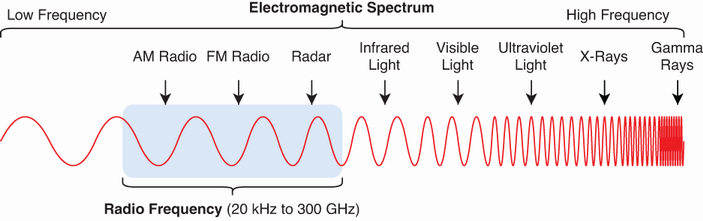
Use the electromagnetic-spectrum figure to place RF relative to other wave types and retain its approximate 20 kHz–300 GHz range. section 18.2.2
