A radius is the distance from a circle’s center to its circumference. Geometrically, it controls how tightly a circle bends: a smaller radius produces stronger curvature, while a very large radius makes an arc resemble a straight line. section 5.2.3
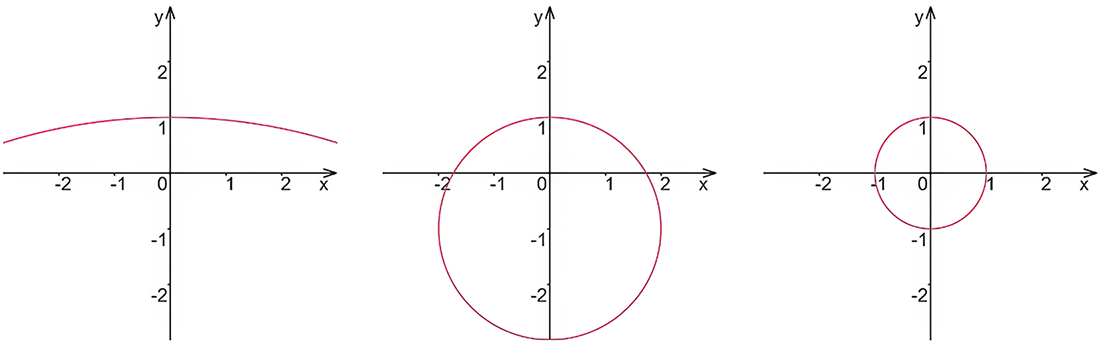
Compare circles with different radii to see why curvature increases as radius decreases. section 5.2.3
Radius becomes especially useful when constructing smooth curve segments:
- Approximate a curve near a point with a fitting circle whose radius reflects the curve’s local bending. section 5.2.3
- Use tangent-vector changes, not merely a shared point and tangent, to determine the appropriate radius. section 5.2.3
- For a biarc, solve for two radii and two circle centers so the arcs meet continuously and smoothly. section 5.3.1
A radius in a biarc
A biarc connects two points while following specified tangent vectors. Its construction represents each point-to-center vector as a rotated, normalized tangent vector scaled by its radius, then constrains the circles’ center distance to equal the sum of their radii. SymPy can solve the resulting system for the centers and radii. section 5.3.1



