ReAct interleaves language-model reasoning with actions that interact with an environment. A related runtime structure is the Perception-Reasoning-Action (PRA) loop: perceive evidence, reason about the next step, act, and observe the result before continuing. The PRA loop provides an architectural frame for iterative agent behavior; a single PRA pass need not include tool use. section 2.1.2 section 2.6.1
Two surrounding loops add capabilities without replacing the core cycle. Reflection evaluates the result and can trigger another cycle, revise the plan, or stop. Memory retains selected observations, decisions, and outcomes for later retrieval; persistence alone is not learning. section 2.1.2
Start with one review pass
Argus reviews a code diff using the diff and optional context as perception, one model call as reasoning, and parsed JSON as the action. This deliberately minimal skeleton has no tool calls, memory, reflection, or prior reviews. It makes the phases visible, but does not yet demonstrate an interleaved reasoning-and-tool-action loop. section 2.6.1
Longer loops can amplify errors. With a 95% success rate per step, the illustrative calculation yields about 60% success over 10 steps and 36% over 20. Reduce unnecessary iterations, improve the evidence available at each step, verify intermediate results, and fail fast when state is corrupt. section 2.1.2 section 2.7
Figure 2.2 The Perception-Reasoning-Action loop with reflection and memory sub-loops. Observe Result is a phase of the loop, not an eighth module.
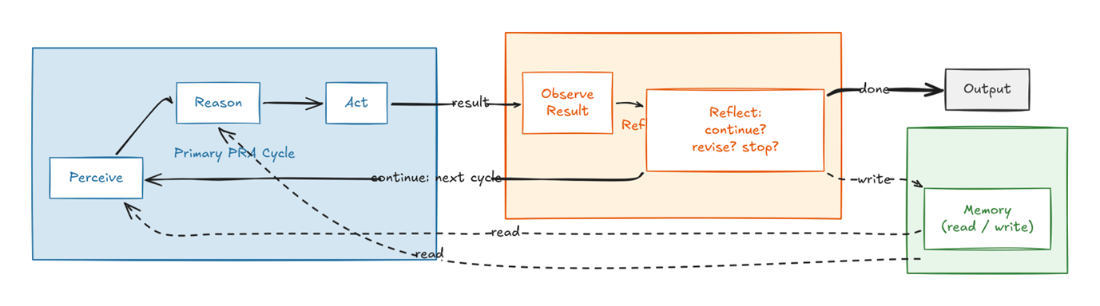
Follow the primary cycle and see where reflection and memory connect across iterations. section 2.1.2














