Red-teaming is adversarial evaluation: probe a deployed model deliberately to uncover failure modes and unwritten expectations before users do. Findings become additions to the behavioral specification, making the contract more testable, versioned, and auditable. section 8.5.5 section 7.6.4
A practical red-team loop is:
- Probe the deployed model with adversarial prompts and varied attempts to expose behavior the current specification does not constrain. section 8.5.5 section 4.4.5
- Record the failure modes and identify the expectation or requirement that was missing from the specification. section 8.5.5
- Turn useful findings into new specification clauses, then retrain or realign the model against the revised contract. section 8.5.5
Safety evaluation
An adversarial prompt may fool both the evaluated model and an LLM judge. Treat red-teaming as one layer of defense, alongside rule-based filters and human review of flagged content. section 4.4.5
Figure 8.6 Where each alignment technique acts in the model lifecycle. Model spec midtraining acts between pretraining and post-training, on documents about the spec. RLHF, Constitutional AI / RLAIF, and deliberative alignment are done during post-training time, all split into the SFT and RL phases. Deliberative alignment enables the model to reason over principles while generating.
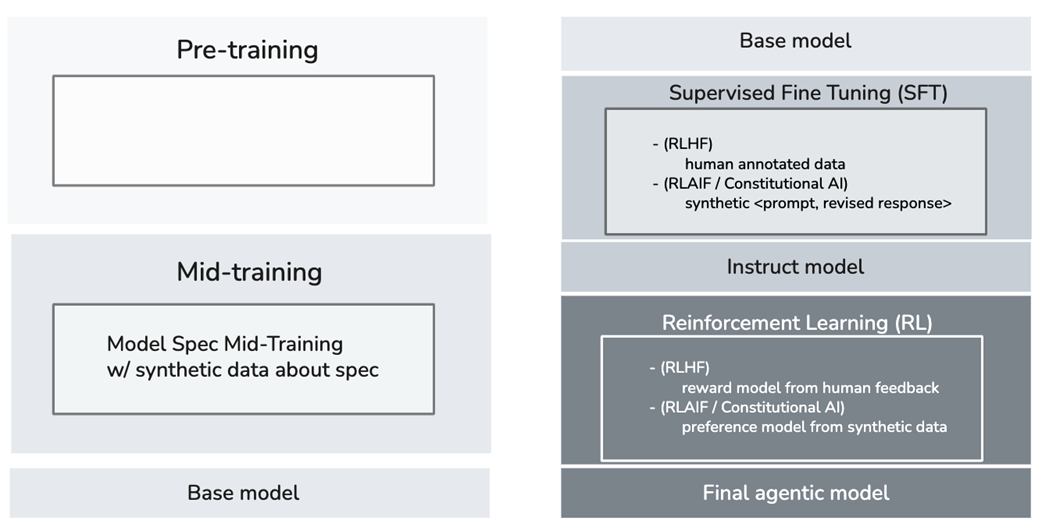
Use the lifecycle view to place red-teaming's findings upstream of specification updates and downstream alignment techniques. section 8.5.5







