Replication maintains copies of data across storage systems, nodes, regions, or environments. It supports durability and availability, but introduces tradeoffs involving consistency, latency, recovery time, cost, and operational complexity. section 5.1.3 section 5.4
Apply replication according to the storage architecture and recovery objective:
- Colocated storage commonly uses software-managed replication, such as HDFS three-way replication; it offers low latency but couples capacity growth to compute and can require slow rereplication. section 5.4
- Object storage typically provides automatic redundancy across nodes or regions, while cross-region replication protects against loss of a cloud region or account. section 5.1.3 section 11.3.7
- Treat Iceberg replication as a coordinated operation across data files, metadata files, snapshots, and catalog state; copying files alone does not preserve a usable table. section 5.1.3 section 11.3.3
Cross-region Iceberg recovery
Configure object storage replication for table data and metadata, back up catalog state, rewrite absolute paths for the destination region, then register and validate the restored table through an automated recovery workflow. section 11.3.3 section 11.3.7
Figure 11.6 Regular backups, not just of data files but also of metadata files and catalog state, can speed disaster recovery and ensure that storage is in sync with the catalog after recovery.
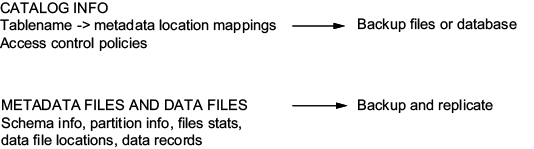
Use the recovery architecture diagram to trace how backups, replicated storage, metadata, and catalog state remain synchronized. section 11.3.7












