Replication maintains multiple copies of data across nodes. If one node is unavailable, other holders can answer requests, while the returning node can catch up on missed changes. section 1.1.1
Replication also distributes data ownership as a cluster grows. Adding a node lets the system assign it some existing data slices rather than relying on a single machine. section 1.1.1 section 1.4
The number of replicas required to respond creates a practical trade-off:
- Require every holder for the most up-to-date result, accepting more internal coordination. section 1.1.1
- Require one holder for immediate availability, accepting that the answer may not be the newest. section 1.1.1
- Require two of three holders to tolerate one loss while favoring a recent result. section 1.1.1
Figure 1.5 ABC Data’s approach gives you control over availability and correctness.
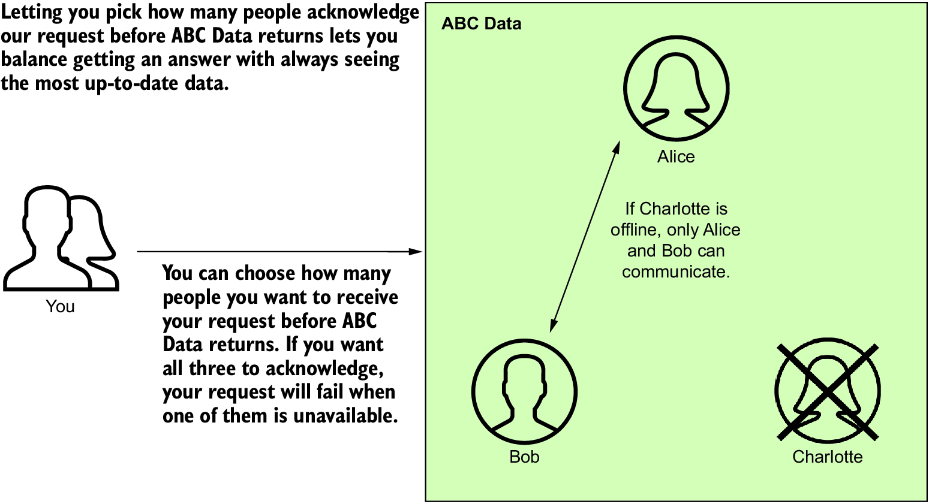
Use the figure to compare how replica-response requirements change the balance between availability and correctness. section 1.1.1












