A reset gate is a GRU mechanism that controls how much of the previous hidden state contributes to computing the candidate hidden state. This selective forgetting helps sequence models handle long-range dependencies in complex molecular structures. section 10.4.2
At each sequence step, the reset gate:
- Combines the previous hidden state and current input through learned weights and a bias, then applies a sigmoid to produce values between zero and one. section 10.4.2
- Filters the previous hidden state before the candidate state is computed; lower values suppress prior information, while higher values retain it. section 10.4.2
- Works alongside the update gate, which blends the candidate state with the previous hidden state to produce the next state. section 10.4.2
Molecular sequence continuity
When processing a SMILES string such as CC(C)CC(=O)NC1=CC=C(C=C1)O, gated memory helps track an earlier parenthesis or ring opening until its later closure. The reset gate controls how much of the prior context enters each candidate state. section 10.4.2
Figure 10.6 Internal architecture of a Gated Recurrent Unit (GRU) cell. The diagram illustrates the information flow through a GRU cell, showing the two key gates (reset gate rt and update gate zt) that control memory retention and updates. The reset gate determines how much previous hidden state information to retain when computing the candidate hidden state h̃t, while the update gate controls the blend between the previous hidden state ht-1 and the new candidate state to produce the final output ht. The mathematical equations on the right define the computations for each component, with σ representing the sigmoid activation function and ⊗ denoting elementwise multiplication.
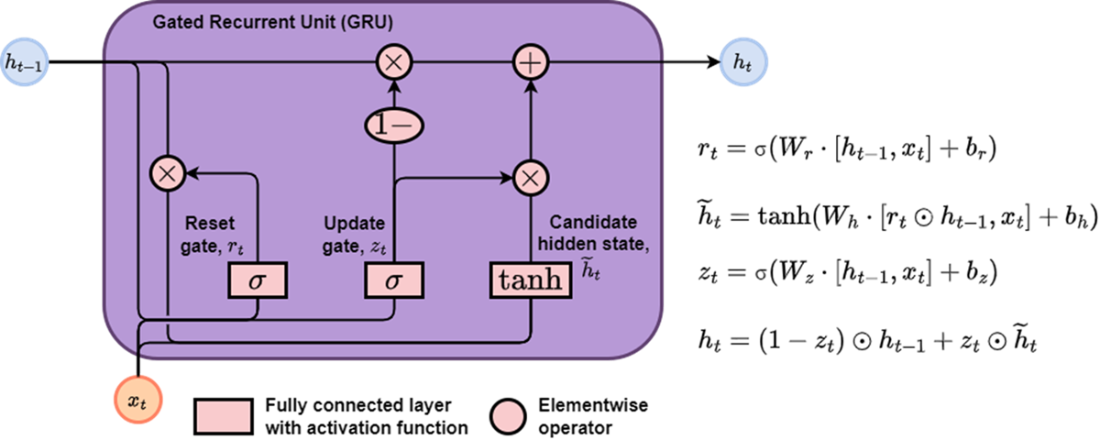
Inspect the GRU-cell diagram to follow reset-gate information flow and its interaction with the update gate. section 10.4.2


