Image resolution specifies an image’s spatial dimensions and the discrete visual detail those dimensions represent. Diffusion systems distinguish working resolution from final display resolution: latent images can have shape 4 × 64 × 64, while VAE decoding produces 3 × 512 × 512 color images. Higher-resolution generation therefore handles greater dimensionality and more complex spatial and color relationships. section 9.3.3 section 7.5
Resolution enters the generation pipeline in several distinct ways:
- Direct diffusion on high-resolution images increases training and inference cost, so latent diffusion performs the process in a smaller space. section 9.5
- The lower-dimensional latent representation improves speed but reduces image quality until a variational autoencoder decoder reconstructs the high-resolution output. section 9.1 section 9.5
- Stable Diffusion exposes output dimensions directly; one demonstrated generation uses width 768 and height 512 instead of the 512 × 512 example. section 10.1
- Increasing resolution demands deeper U-Nets and attention mechanisms to preserve relevant fine details amid larger feature representations. section 7.0 section 7.5
From latent image to final image
A latent diffusion model progressively denoises a 4 × 64 × 64 latent image, then passes the clean latent through a pretrained VAE decoder to obtain a 3 × 512 × 512 image. The banana-shaped rider becomes clearer as denoising advances, while decoding converts each intermediate latent into a high-resolution view. section 9.3.3
Figure 9.9 Converting the intermediate latent images into the high-dimensional space. The five latent images in figure 9.8, each with a shape of 4 × 64 × 64, are converted by the pretrained VAE decoder into the high-dimensional space, with a shape of 3 × 512 × 512.
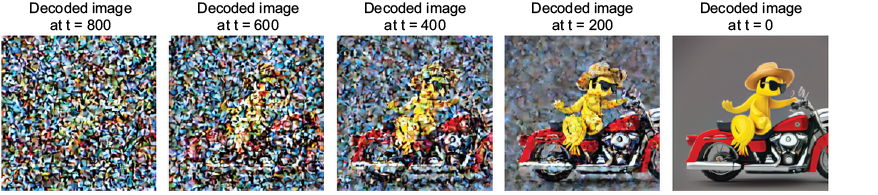
Inspect the concrete shape transition from five 4 × 64 × 64 latent images to five 3 × 512 × 512 decoded outputs. section 9.3.3



