Rollback restores a deployed system to a previously known version or configuration after a problematic change. In a production deployment, it is the recovery path when the new version’s application-level error rate exceeds the established baseline. section 9.7 section 9.5.1
A production rollback pattern combines:
- Incremental rollout: Kubernetes replaces pods progressively, keeping old and new versions active during the transition. section 9.7
- Application-level monitoring: the Workflow Service compares new-version error rates with the old version’s baseline rather than relying only on container health checks. section 9.7
- Versioned deployment state: each deployment increments a workflow version, allowing the service to identify and restore the previous version. section 9.5.1
- Explicit service support: deployment operations include status checking and a RollbackWorkflow operation for the deploy CLI. section 9.5
Automated deployment rollback
A developer deploys an updated container image. Kubernetes performs a rolling update while the Workflow Service watches error rates through the Observability Service. If errors rise significantly above the previous baseline, the service reverts the Deployment to its previous container image. The same progressive-enforcement principle applies to new policies: shadow evaluation and canary traffic reduce blast radius before full enforcement, with automatic rollback available when the change causes widespread failures. section 9.7 section 6.9
Figure 9.4 The three consumers of the Workflow Service contract. The deploy CLI connects to registry operations (RegisterWorkflow, UpdateWorkflow, DeleteWorkflow) and deployment operations (DeployWorkflow, RollbackWorkflow). The SDK's runtime server inside workflow containers connects to job operations (CreateJob, UpdateJobProgress, CompleteJob, SaveJobCheckpoint , FailJob). External clients connect to job operations (GetJobStatus, CancelJob) and optionally to deployment status (GetDeploymentStatus).
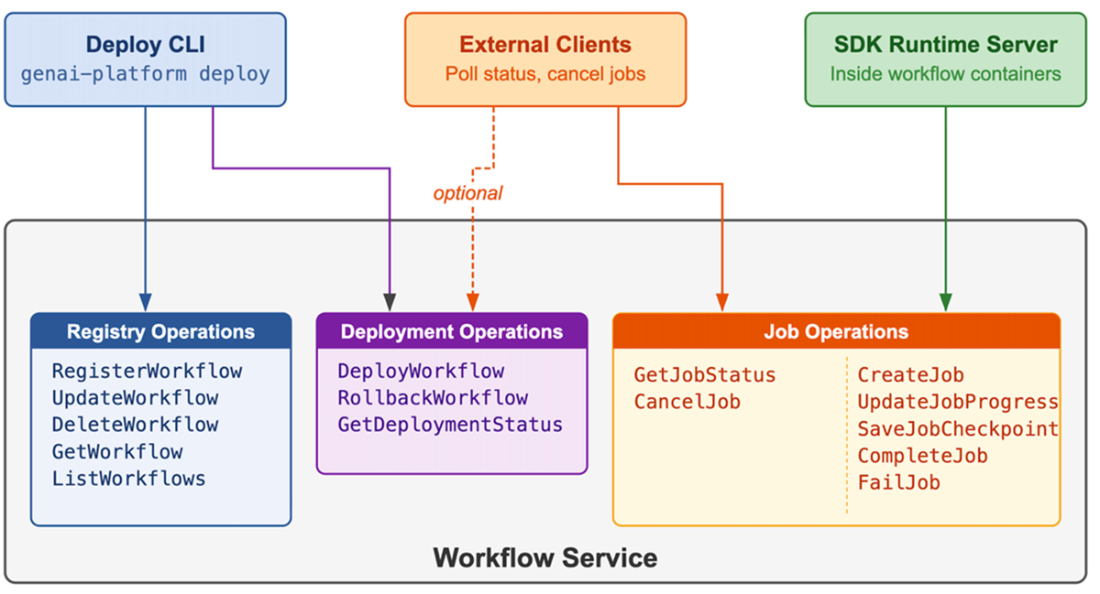
Inspect the Workflow Service consumers and operations that connect deployment status, DeployWorkflow, and RollbackWorkflow. section 9.5