Root mean squared error (RMSE) measures the typical size of numeric prediction errors by taking the square root of their mean squared differences. Lower values indicate smaller prediction errors. section 4.3
Use RMSE to make regression evaluation consistent and comparable:
- Place the data transformations and regression model in one pipeline. section 4.3
- Measure RMSE with the same cross-validation strategy used across candidate models. section 4.3
- Report the average and standard deviation of the cross-validated RMSE to assess consistency across samples. section 4.3
Comparing Airbnb price models
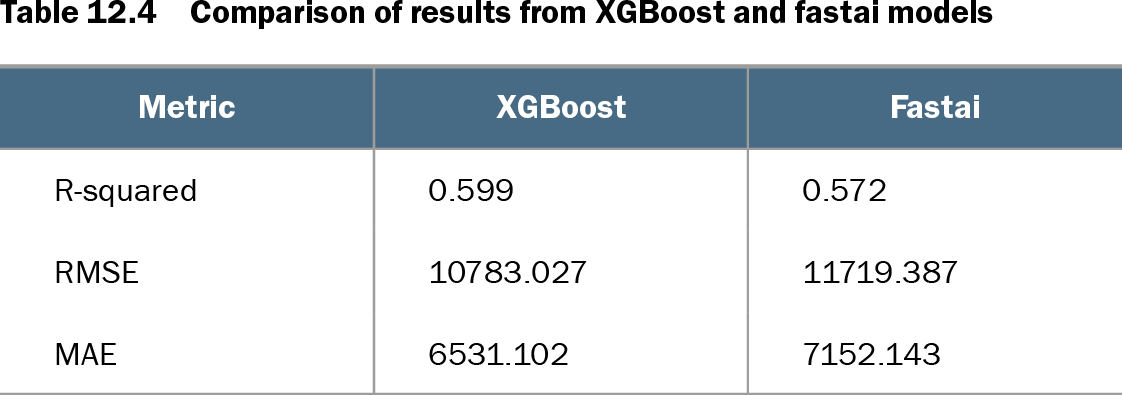
For the Tokyo Airbnb problem, XGBoost achieved an RMSE of 10,783.027, while fastai achieved 11,719.387. Alongside R-squared and MAE, these values show that XGBoost produced the stronger overall result, with RMSE about 8% to 9% lower. section 12.4
Table 12.4 Comparison of results from XGBoost and fastai models (view table figure)
| Metric |
XGBoost |
Fastai |
|---|---|---|
| R-squared |
0.599 |
0.572 |
| RMSE |
10783.027 |
11719.387 |
| MAE |
6531.102 |
7152.143 |
Compare RMSE, MAE, and R-squared values for the XGBoost and fastai solutions in a compact results table. section 12.4