A record is a row: one related set of values arranged across the columns of a table. Spreadsheet rows provide a familiar model for understanding database records. section 2.1 section 2.4
Figure 2.3 The spreadsheet of books, with the first horizontal collection of data highlighted to show the horizontal nature of rows
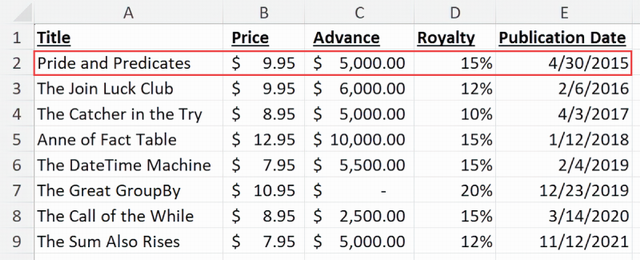
Use the highlighted horizontal line to see how one record contains values for the table’s columns in a fixed order. section 2.1
A record has several practical properties:
- Represents one item of the kind stored by the table; in the example data, each record represents one book title. section 2.1
- Follows the table’s column structure, with one position for every column, such as Title, Price, Advance, Royalty, and Publication Date. section 2.1
- Contains a value for each column, although a particular value may be absent when the table permits NULL or another missing-value representation. section 2.1 section 16.1
- May exist without an explicit identifier displayed beside it; row numbering is not necessarily part of the table design. section 2.1
Reading and adding records
In the book data, the record for The Sum Also Rises includes a Title value of The Sum Also Rises and a Price value of $7.95. When data is inserted into an existing table, the operation adds a new record whose properties are supplied through the table’s columns. When data is updated, the operation changes values within one or more records rather than replacing the row concept itself. section 2.1 section 16.1 section 17.1











