liveBook · Manning

Record

As explained in The Well-Grounded Python Developer: How the pros use Python and Flask

A database record is a stored row representing one set of related field values in a database table.

A database record is one stored row containing a related set of field values. In a table, each row represents an individual record, while each column represents a field. This structure improves on a single CSV row by giving fields defined data types instead of treating every value as text. section 10.3.1 section 10.2

A record participates in a database structure through several related parts:

  • Fields hold values such as names, addresses, product names, quantities, integers, decimals, or binary objects. section 10.3.1
  • A primary key uniquely identifies the record within its table. section 10.3.1
  • A foreign key connects the record to a primary key in another table, allowing related data to be stored separately. section 10.3.1

From order data to database records

An online store may begin with CSV rows containing a customer, address, product, and quantity. Repeating customer and address values across orders creates redundancy. Separate Customer, Address, Product, and Order records reduce that repetition. SQLAlchemy models turn parsed CSV data into model instances, and session.commit() persists them, generating primary-key values used when creating related orders and items. section 10.2 section 10.7.1
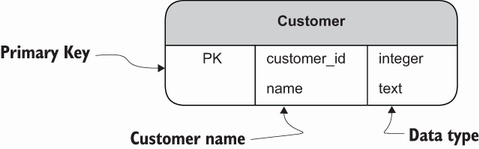
Figure 10.6 The ERD diagram for the Customer table showing the field names and data types

Use the Customer ERD to inspect how a record’s fields, data types, and primary key are represented visually. section 10.3.1


How The Well-Grounded Python Developer: How the pros use Python and Flask covers it

How deep it goes
Defines records, typed fields, primary keys, foreign keys, and persistence, then demonstrates creation through SQLAlchemy.
Examples
Uses online-store customers, addresses, products, orders, CSV rows, ERD diagrams, and SQLAlchemy-created model instances.
What it assumes
Assumes familiarity with CSV rows and fields while developing database tables, data types, and key-based relationships from that foundation.
What you can do after
Apply it via SQLAlchemy by converting parsed CSV data into model instances and committing persistent records with related identifiers.
How it connects
Connects records to database tables, fields, primary keys, foreign keys, CSV files, and SQLAlchemy models.

Also explained in

Compare how 12 books explain record →

Related concepts

This explainer was generated by Manning's knowledge graph from the text of The Well-Grounded Python Developer: How the pros use Python and Flask. The section links point to the parts of the book it draws on.









