A record is one row in tabular data: an autonomous collection of values that completely describes a specific observation or data point. Its columns provide the attributes, variables, or features that characterize that observation. section 1.1 section 2.1
A record has several practical characteristics:
- Represents one unit of analysis, such as a DNA sample, industrial product, or property listing. section 2.1
- Contains values whose columns share common data types, including numeric, date, time, or textual forms. section 1.1 section 2.1
- Stands independently from other records while remaining part of a larger tabular dataset. section 1.1
Currency and property records
In a currency table, one record can describe a nation through its country, currency name, symbol, ISO code, nickname, and units per US dollar. In a property-prediction workflow, another record supplies values such as location, rooms, furnishing, bathrooms, car parks, and size as input for a model. section 1.1 section 9.5.2
Figure 1.1 An example of tabular data
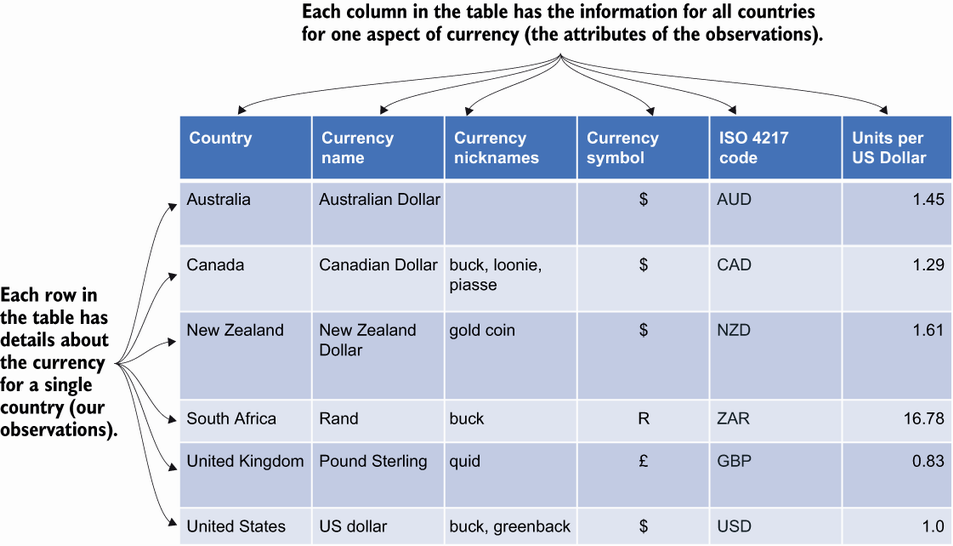
Use the tabular-data figure to see how a record gathers related attribute values across one row. section 1.1











