liveBook · Manning

Symbolic AI

As explained in Build a Reasoning Model (From Scratch)

Reasoning based on explicit symbolic rules rather than statistical associations learned from data.

Rule-based reasoning uses explicit symbolic rules and logical inference rather than statistical associations learned from data. It provides a reference point for understanding how LLM reasoning differs: LLMs can generate intermediate steps and simulate reasoning behavior without explicitly executing rule-based logic. section 1.5 section 1.8

Use the distinction to separate the mechanisms and improvement methods involved:

  • Rule-based systems apply explicit logical rules; LLMs rely on statistical pattern matching learned from data. section 1.8
  • LLM reasoning can be improved through inference-time compute scaling, reinforcement learning, supervised fine-tuning, and distillation without becoming rule-based. section 1.5 section 1.8
Figure 1.7 An illustrative example of how a language model (GPT-4o in ChatGPT) appears to “reason” about a contradictory premise
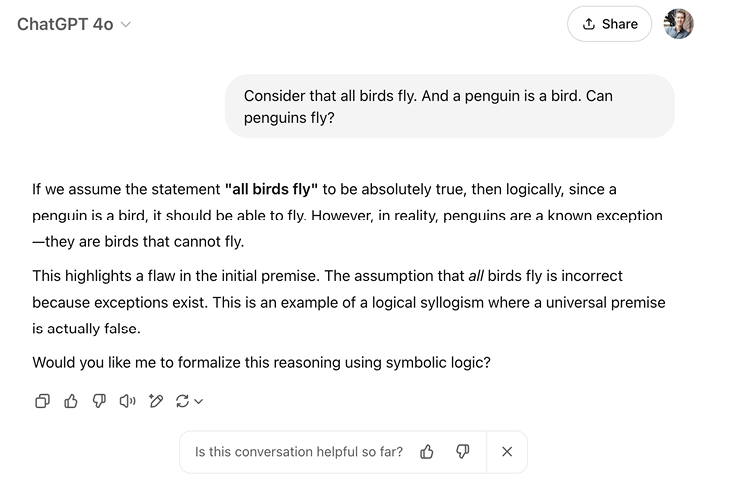
Inspect an example of apparent LLM reasoning about a contradictory premise, then compare its behavior with explicit rule execution. section 1.5


How Build a Reasoning Model (From Scratch) covers it

How deep it goes
Defines the distinction and compares mechanisms, but stops short of specifying a rule-engine implementation or inference algorithm.
Examples
Uses an LLM response to a contradictory premise as an example of apparent reasoning without explicit rules.
What you can do after
Evaluate whether a reasoning behavior reflects explicit logical inference or statistical pattern matching.
How it connects
Connects rule-based reasoning with logical reasoning, statistical pattern matching, chain-of-thought, reinforcement learning, and inference-time compute scaling.

Also explained in

Compare how 5 books explain symbolic AI →

Related concepts

This explainer was generated by Manning's knowledge graph from the text of Build a Reasoning Model (From Scratch). The section links point to the parts of the book it draws on.


