Scope sets the boundary of what an application will and will not do. Writing both sides prevents users and collaborators from assuming features that are not planned. section 3.3.1
Define scope by making deliberate choices about requirements, complexity, and future versions:
- List the features users need, then remove work that does not directly support the application’s goal. section 3.3.1 section 4.1.2
- Defer functionality that introduces a new dependency or difficult problem. A simple unit converter can use fixed factors, while currency conversion requires changing exchange rates and an external API. section 3.3.1
- Record exclusions as well as inclusions. This supports prioritization, phasing, and conversations with stakeholders about a later version. section 3.3.1
A daily to-do list
A deliberately narrow to-do app lets users view, add, remove, complete, and undo tasks, and see completion totals. It does not retrieve tasks after refresh, export them, or save their history. The app therefore remains within one browser session and starts with a blank slate each day. section 4.1.2
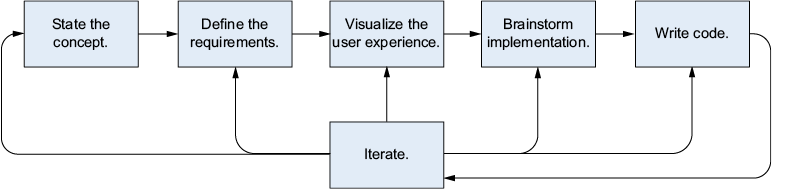
Use the six-step workflow to place scope inside development: state the concept, define requirements, visualize the user experience, brainstorm implementation, write code, and iterate. Scale each step to the project. section 3.1








