The search space is the set of product components and design choices through which an AI product creates value while managing feasibility, usability, privacy, and governance risks. It spans data, intelligence, and user experience rather than AI models alone. section 1.3.2
Map the space across several connected decisions:
- Data: choose modalities and determine whether data is labeled or unlabeled; quality, coverage, bias, and alignment with real requests shape output quality. section 1.3.2 section 3.4
- Intelligence: match the problem to predictive, generative, or agentic AI and select models or algorithms that transform inputs into useful outputs. section 1.3.2 section 3.4
- User experience: decide how people interact with the system through conversational, graphical, or hybrid interfaces, and how control is divided between people and AI. section 3.4
- Constraints: account for governance requirements across data, intelligence, and user experience, including privacy, regulation, cost, and infrastructure choices. section 1.3.2 section 3.0
Movie-review sentiment
A streaming platform initially uses GPT-4o with lengthy few-shot prompts to classify review sentiment. The feature is popular but expensive and raises privacy concerns. A small logistic-regression model proves faster, fairly accurate, and suitable for internal hosting, showing why teams should compare alternatives across the whole search space. section 3.0
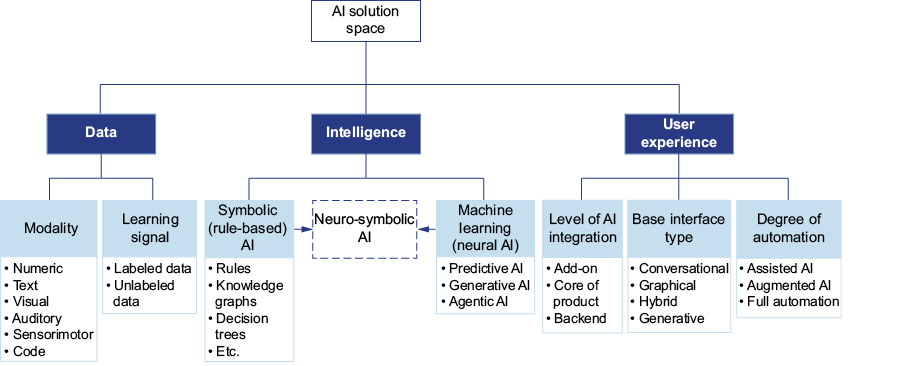
Use the categorization map to compare data modalities, AI system types, interfaces, and degrees of automation before committing to a solution. section 3.0










