liveBook · Manning

Self-loop

As explained in Graph Neural Networks in Action

A graph edge that connects a node to itself and, in this recurrent-model diagram, represents a temporal state update.

A self-loop is an edge connecting a node to itself. In an adjacency matrix, it appears as a nonzero diagonal entry, preserving the node’s own information alongside relationships with other nodes. section 1.2.1

In a GCN message-passing step, self-loops support this sequence:

  • Adjust graph nodes to include self-loops. section 3.4.3
  • Multiply node embeddings by the trained weight matrix. section 3.4.3
  • Apply symmetric normalization while aggregating neighborhood and starting-node information. section 3.4.3
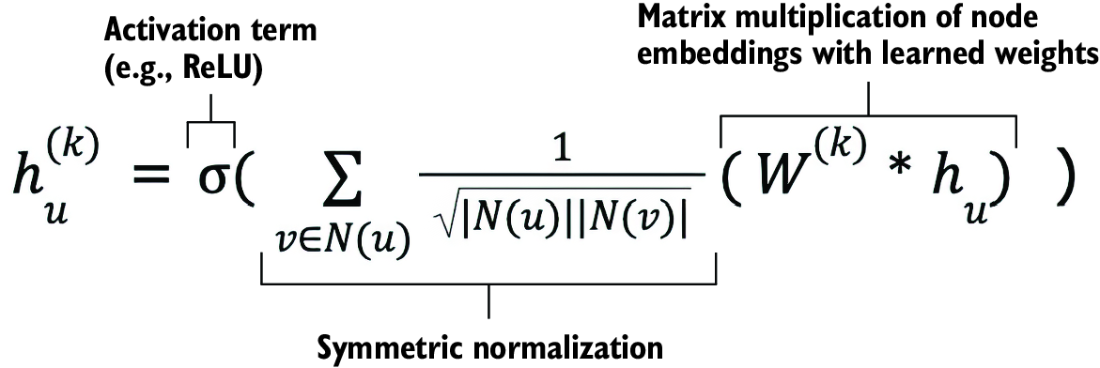
Figure 3.16 Mapping of key computational operations in the GCN embedding formula
figure

Use the computational mapping to trace how a self-loop lets a node’s original embedding participate in the GCN update. section 3.4.3


How Graph Neural Networks in Action covers it

How deep it goes
Defines self-loops through adjacency-matrix diagonals and places them in a short GCN preprocessing and aggregation sequence.
Examples
Shows self-loops as nonzero adjacency-matrix diagonal entries and as part of the GCN embedding computation.
What it assumes
Assumes basic graph and adjacency-matrix terminology while defining self-loops from those structures.
What you can do after
Operate/configure GCN preprocessing by adding self-loops before weight multiplication and normalized message aggregation.
How it connects
Connects self-loops with graphs, adjacency matrices, node embeddings, GCNs, message passing, and symmetric normalization.

Also explained in

Compare how 2 books explain self-loop →

Related concepts

This explainer was generated by Manning's knowledge graph from the text of Graph Neural Networks in Action. The section links point to the parts of the book it draws on.