Self-supervised learning trains a model by deriving supervisory targets from the input data instead of requiring manually labeled examples. In language modeling, the model creates its own prediction task from ordinary text. section 13.3.1
A Transformer can randomly mask 15% of the tokens in a sentence and predict the missing words from surrounding context. This masked language modeling task, also called a Cloze test, optimizes a loss function; repeated training produces embeddings that capture words and their contexts. section 13.3.1 section 15.1.2
Masked-token pretraining
Given a sentence such as “The cat sat on the mat,” the training process can hide tokens and require the model to predict them using the remaining words. The resulting representations support later language and search tasks. section 13.3.1
Figure 13.4 The Transformer encoder
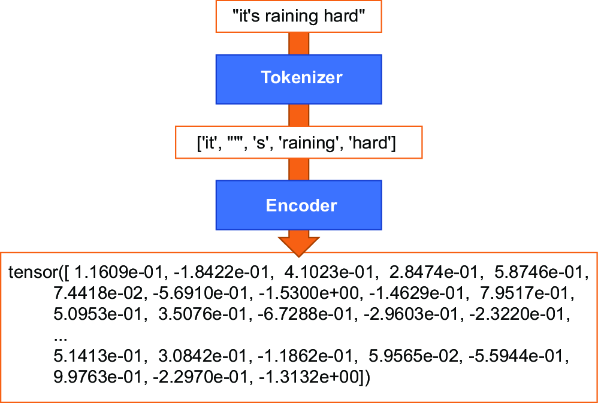
Trace the Transformer encoder pipeline used to turn tokenized text into contextual representations. section 13.3.1







