Self-supervised learning creates supervisory signals from data itself, allowing models to learn without manually labeled examples. It supports foundational models that learn general representations from large text, code, image, audio, and 3D datasets. section 2.1
The technique contributes to adaptable AI systems by:
- Learning representations that transfer across tasks rather than serving only one narrowly defined task. section 2.1
- Supporting applications such as machine translation, question answering, object recognition, scene understanding, and robotic navigation. section 2.1
- Working with unstructured and spatial data, including text, code, images, audio, point clouds, medical scans, and 3D models. section 2.1
Cross-task model reuse
A foundational model can learn broad language representations from extensive text and code, then support translation or question answering even when those tasks were not its explicit training objective. section 2.1
Figure 2.1 Foundational model overview
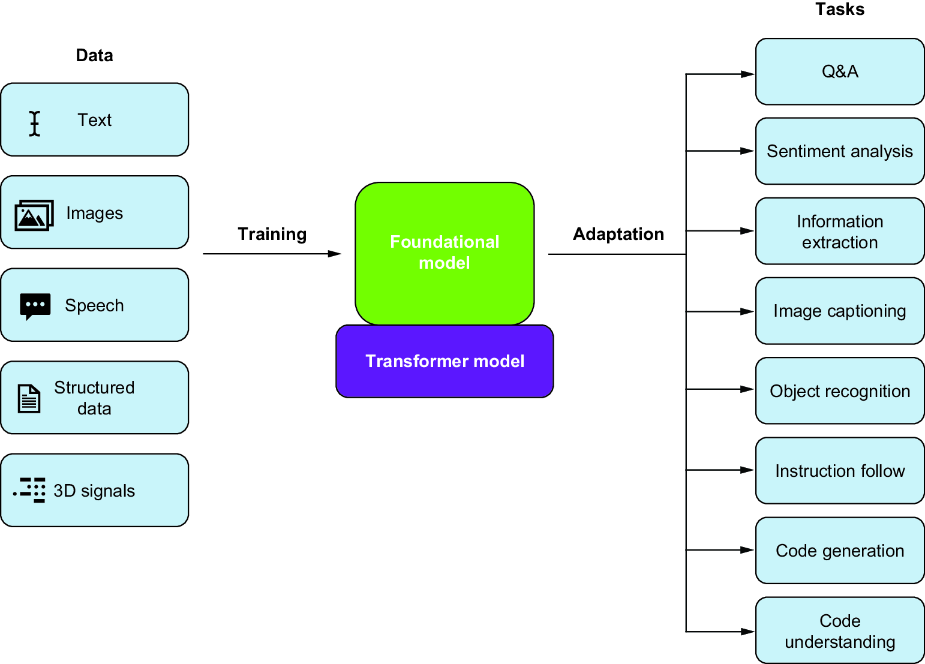
Use the foundational-model overview to relate self-supervised learning to deep learning, transfer learning, and generative AI. section 2.1







