Semi-supervised learning combines labeled pairs (X, Y) with unlabeled feature examples (X). Labeled data supports learning P(Y|X), while unlabeled data informs P(X); the practical question is whether that extra information improves prediction. section 5.3.2
The approach is most useful when labels are costly but examples are plentiful. A causal interpretation asks whether unlabeled X updates the joint representation P(X, Y) in a way that improves prediction of Y. section 5.3.2
Causal structure supplies a test for when unlabeled examples should help:
- Expect stronger justification in anti-causal learning, where the label causes the features. section 5.4
- Expect weaker justification in causal learning, where the features cause the label. section 5.4
- Use these distinctions to avoid spending labeling effort, computation, and personnel time on unsuitable problem settings. section 5.4
Image moderation
A social media platform may have many uploaded images but few labels indicating gratuitous violence. Human labeling is expensive and mentally stressful; semi-supervised learning aims to reduce the required labeling workload. section 5.3.2
Figure 5.16 In causal learning, the features cause the label. In anti-causal learning, the label causes the features.
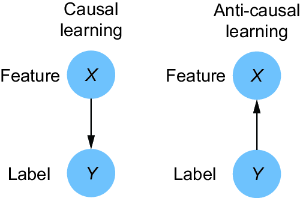
Compare causal and anti-causal directions to assess whether unlabeled feature data is likely to inform label prediction. section 5.4




