Semi-supervised learning combines labeled and unlabeled examples during training. In graph problems, unlabeled nodes can contribute neighborhood and structural information even when their labels remain unknown. section 9.2.1
The approach is especially relevant to node classification and link prediction, where the full graph is available but labels are missing for some nodes. Classical formulations assume independent, identically distributed data; graph dependencies violate that assumption. section 9.2.1 section 9.4
Predicting Flickr interests
Flickr user connections form a graph, while interest-group memberships provide labels. Multilabel node classification can predict groups that users may join but have not yet joined. section 9.2.1
Figure 9.2 The typical flow of node classification. Like many supervised ML tasks, it has two phases: training and prediction (which, in this case, translates into classifying unclassified nodes).
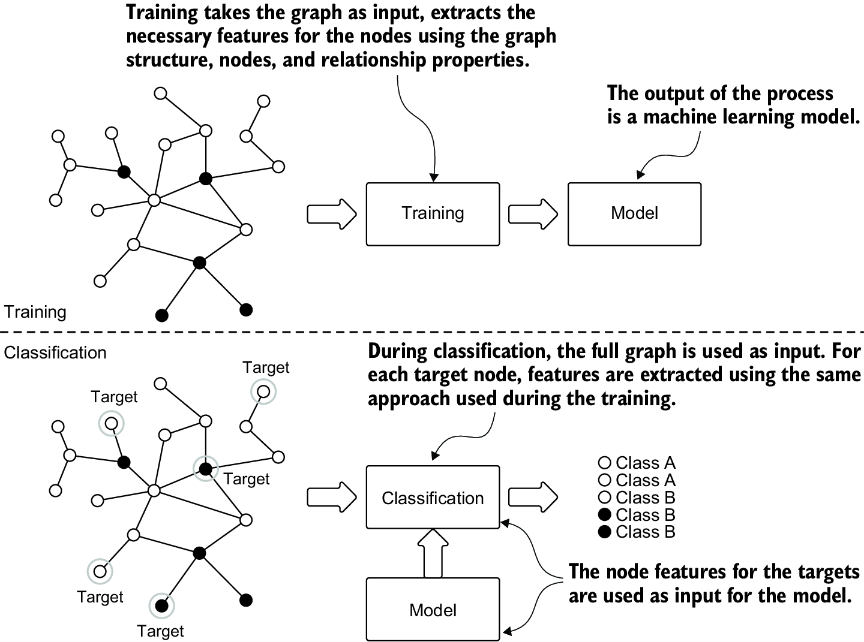
Use the node-classification flow to distinguish training from prediction over labeled and unclassified nodes. section 9.2.1




