An encoder-decoder architecture handles both generative and non-generative tasks by encoding an input sequence and decoding a separate output sequence. It fits problems where the input is large but the desired output is relatively small. section 4.1.4
Translation and summarization
A long source passage can be encoded and converted into a shorter translation or summary. This contrasts with encoder-only architectures, which focus on extracting context, and decoder-only architectures, which generate text by predicting subsequent tokens. section 4.1.4
Figure 4.4 Traditional classification models use supervised learning to predict one of several predefined classifications. They look for the intent, or meaning, of a user input. Generative models use decoding transformers to create a text completion. They predict the next sequence of tokens (loosely, words or characters) that are most likely to occur after the user input.
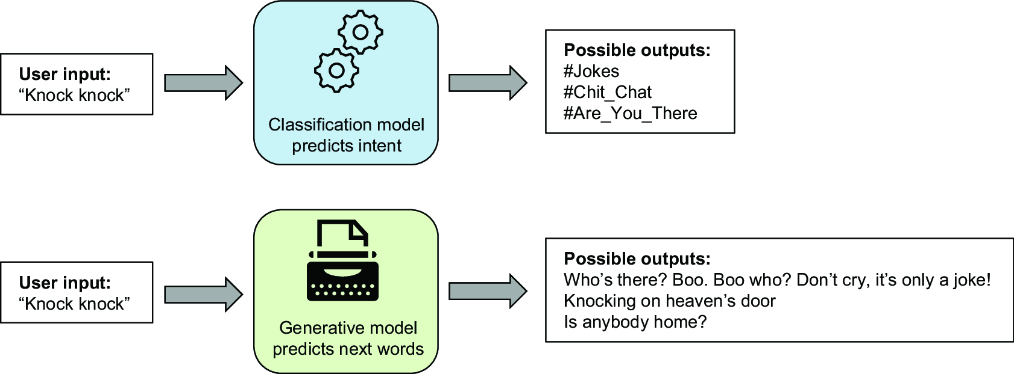
Compare classification models, which select among predefined intents, with generative models, which decode likely continuations. section 4.1.4









