A sequence-to-sequence (Seq2Seq) model maps an input sequence X = (x₁, …, xT) to an output sequence Y = (y₁, …, yT′). The sequences may contain different tokens, lengths, ordering, and multiple valid mappings, making Seq2Seq more suitable than an RNN that emits one output for every input item. section 11.0 section 11.1
The model separates processing into an encoder and decoder. The encoder converts the source sequence into hidden states; the decoder generates target tokens one at a time. Attention avoids compressing the entire input into one vector: at each decoding step, it weights encoder states and forms a context vector x̄t = Σᵢ αᵢhᵢ. section 11.1 section 11.1.1
An attention-based implementation proceeds through four recurring stages:
- Run the source sequence through an encoder, such as PyTorch nn.GRU, and retain hidden states h₁ … hT. section 11.4
- Use a decoder RNN cell to produce a context for the current output position, using the previous decoder state or token according to the decoding strategy. section 11.1.1 section 11.4
- Score the decoder context against encoder states, normalize the scores into α₁ … αT, and compute the weighted attention context. section 11.4
- Concatenate the attention context with the decoder context, project it through a fully connected layer, and predict the next token until EOS or a maximum length. section 11.4
English-to-French translation
For input “what a nice day,” the target may be “quelle belle journée.” The target can reorder words and differ in length. A trained model may translate “some animals are afraid of fire” as “les animaux ont peur du feu,” while attention scores show which source words influenced each output token. section 11.2
Training commonly combines autoregressive decoding with teacher forcing. For outputs shaped (B, T, V), apply cross-entropy at each time step and ignore padding with ignore_index so the model learns to emit EOS rather than padding. Gradient clipping helps stabilize RNN training; attention heat maps provide an interpretable view of token alignment. section 11.4.2 section 11.6
Figure 11.6 The process of applying attention to predict one item at a time of the output. Each highlighted region shows one of the four steps of encoding, decoding the context, attention, and prediction. This is repeated until an EOS token is found or a maximum limit is reached.
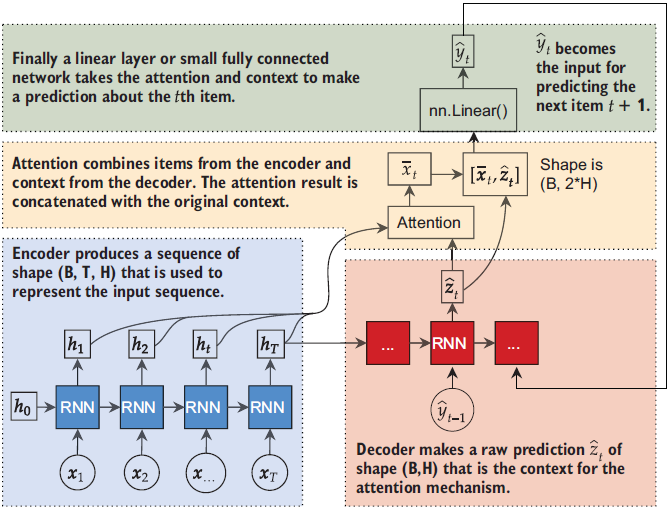
Use the decoding diagram to trace encoding, decoder-context generation, attention, and token prediction for one output position. section 11.4









