Serverless computing runs cloud-native applications without requiring operators to manage the underlying compute infrastructure. Platforms provision capacity, scale containers from requests or events, and expose a simpler deployment experience while retaining application-level configuration. section 9.1 section 9.2.1
A serverless platform typically provides:
- Container-based deployment that supports any language capable of serving HTTPS requests. section 9.1
- Event-driven invocation, request-based autoscaling, and the ability to scale resources to zero. section 9.1 section 9.2.1
- Managed primitives for scaling, observability, rollouts, traffic management, networking, and load balancing. section 9.2.1
- Controls for concurrency and minimum or maximum instances, allowing teams to tune execution behavior without managing Kubernetes internals. section 9.2.1
Knative places this model on Kubernetes, combining serverless simplicity with Kubernetes portability and control. Developers define dependencies, package code in a container, and deploy it; the platform handles serving, scaling, traffic management, and workload observation. Cloud Run provides a fully managed alternative on Google infrastructure, while Knative on Anthos retains cluster-level control, including access to custom GKE hardware such as GPUs. section 9.0 section 9.3.6
Deploying a Knative service
A Kubernetes manifest can define a Knative Service with a container image and environment variable, then deploy it with `kubectl apply -f service.yaml`. Operators can inspect the service, configuration, revision, route, and pods; retrieve its generated URL; and verify the response with `curl`. section 9.3.6
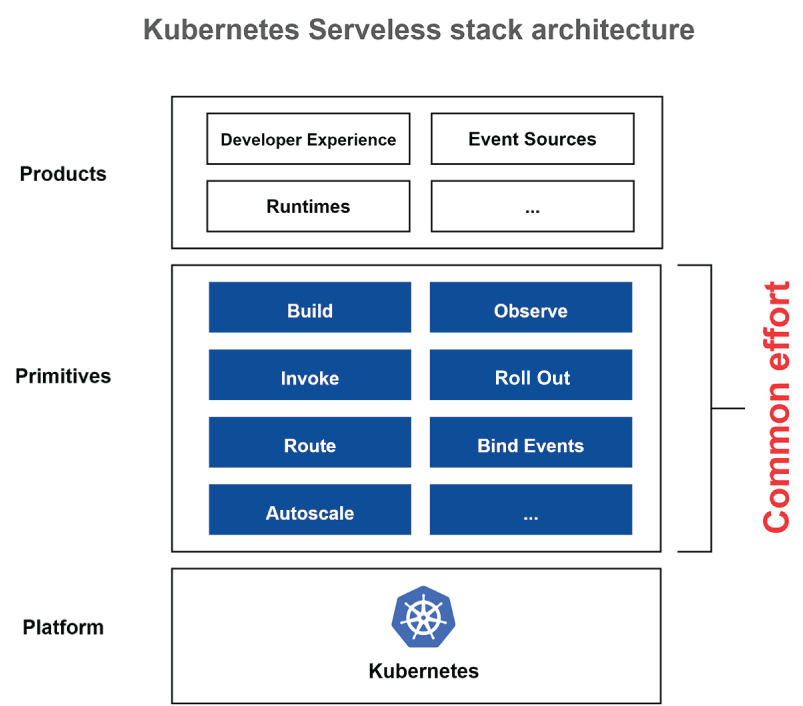
Shows the Kubernetes serverless stack and the components required to deliver serverless workloads on Kubernetes. section 9.2.1








