Severity classifies how important a linting problem is or what kind of attention it needs. A useful diagnostic pairs severity with a meaningful message, location, and suggested solution. section 18.7
Use severity to distinguish the practical response:
- Mark an actual error with error severity; use warn, info, or hint for less urgent findings, improvements, or matters needing investigation. section 18.7.3 section 18.10
- Split rules when one check would mix severities or produce an unclear message. section 18.7.3
- Override imported rule severity when an API’s context requires a different priority. section 18.8 section 18.9.1
Search parameter validation
Create search-q-defined with info severity to report a missing q parameter, then search-q-valid with error severity to reject an incorrectly defined schema. This separates presence from correctness and keeps feedback precise. section 18.7.3
Figure 18.19 A helpful API linter lists meaningful problems, their location, their importance or nature, and how to solve them.
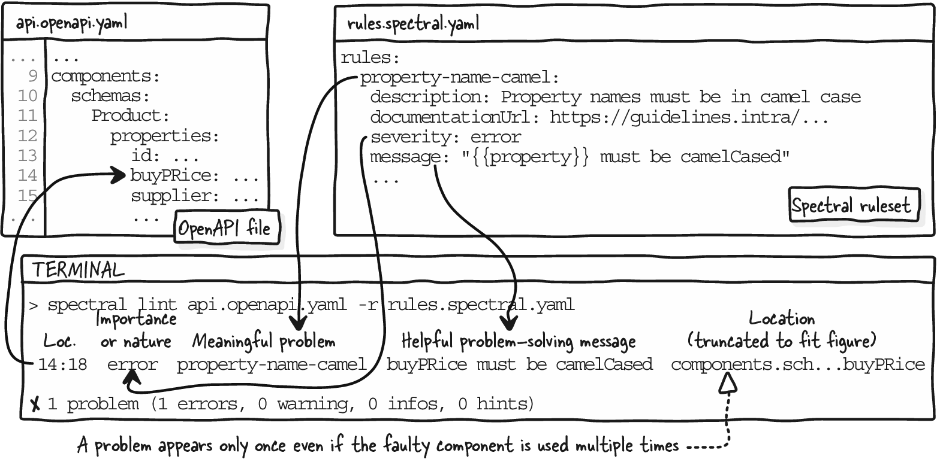
Use the diagnostic layout as a checklist: show the problem, its location, its importance or nature, and how to solve it. section 18.7






