The Sharpe ratio evaluates expected reward per unit of risk: SR = (μ − r_f) / σ, where μ is expected return, r_f is the risk-free rate, and σ is volatility. Comparing returns alone can favor leveraged or unusually volatile investments. section 7.2 section 7.2.1
A leveraged investment
A $1 million investment with a 20% expected return, 15% volatility, and a 5% risk-free rate has a Sharpe ratio of (20% − 5%) / 15% = 1.0. Borrowing another $1 million at 5% doubles expected return and volatility, but the ratio remains 1.0: (40% − 5% − 5%) / 30% = 1.0. section 7.2.1
Figure 7.2 Investments above and below CAL
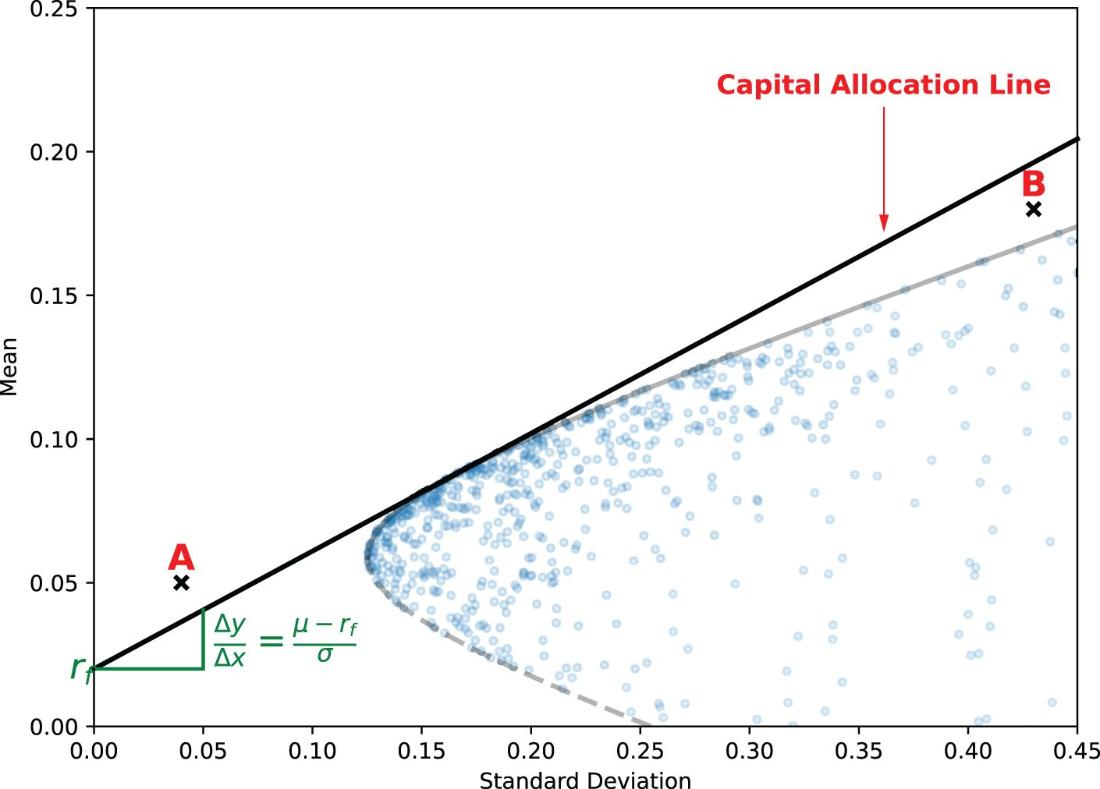
Use the capital allocation line to compare investments by the slope connecting risk-free and risky positions; points above the line offer more expected return for their volatility. section 7.2.1
The denominator includes total portfolio risk, including market and idiosyncratic risk. This makes the Sharpe ratio especially useful when the investment represents the investor’s entire portfolio. section 7.2.4 section 7.3
Choose the measure according to the investment’s role:
- Use the Sharpe ratio when total portfolio risk matters, including risk that cannot be diversified away from the investor’s perspective. section 7.2.4
- Use alpha when evaluating one component of a broader portfolio and non-market, diversifiable risk should be excluded. section 7.2.4

