A similarity metric numerically measures how much two molecules resemble each other through shared features. In ligand-based screening, it ranks library compounds against a molecule with known activity, helping prioritize candidates for experimental validation. section 2.1.3
The result depends on molecular representation as well as the metric. Molecular fingerprints act as binary feature vectors, so similarity compares their shared non-zero features rather than treating structural resemblance as proof of matching biological function. section 2.1.3 section 2.5.1
Common coefficients for binary fingerprints include:
- Tanimoto, also called Jaccard similarity, divides the number of shared non-zero features by the number of non-zero features in either vector. section 2.5.1
- Dice similarity doubles the shared-feature count and divides it by the sum of the non-zero feature counts in both vectors. section 2.5.1
From feature space to molecules
An apple at coordinates (5, 3) and an orange at (3, 4) illustrate how nearby points share feature values. Molecular fingerprints provide an analogous feature-space representation for comparing compounds. section 2.5.1
Figure 2.3 Structure-property relationships are nuanced. Discovering similar molecules doesn’t guarantee desired, similar function with respect to a query molecule.
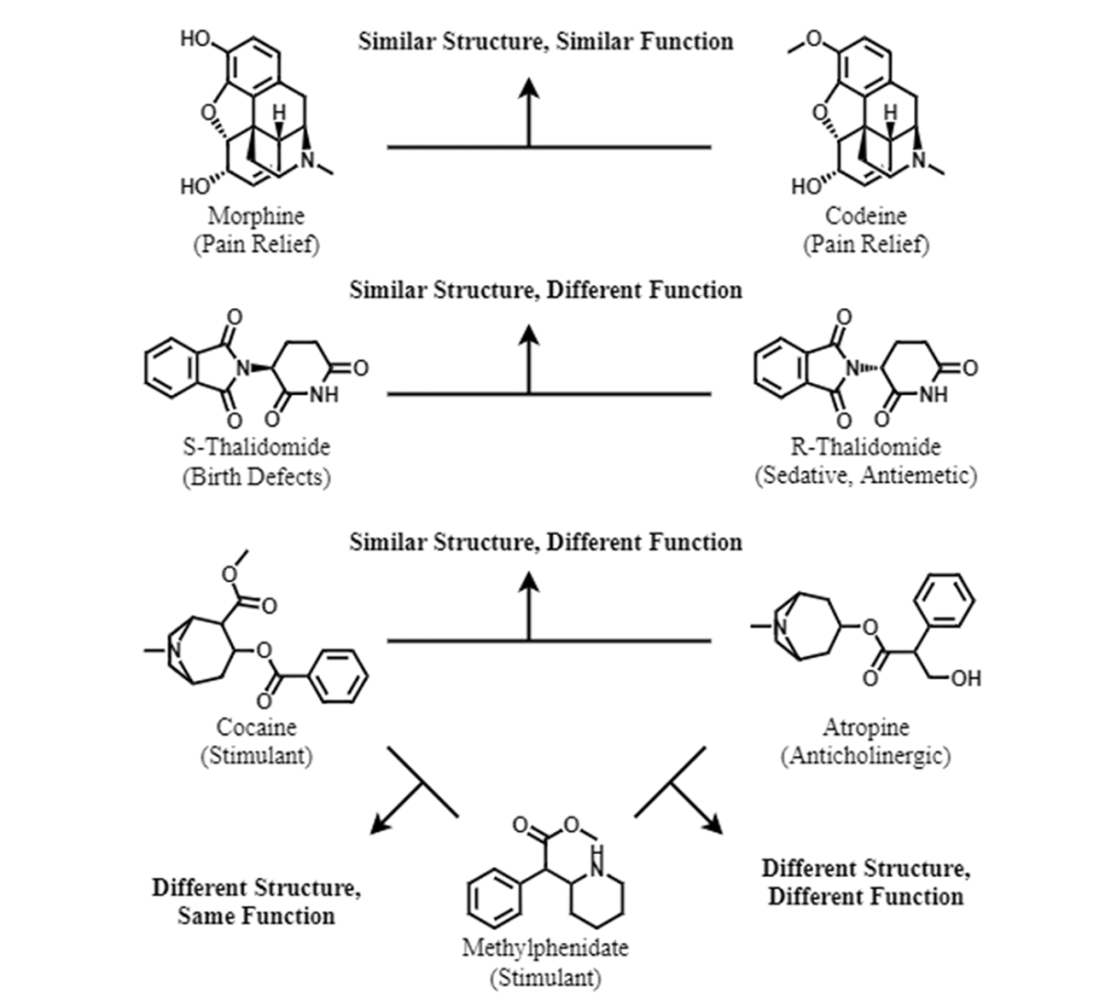
Use the structure–property relationship figure to see why finding structurally similar molecules does not guarantee similar functionality. section 2.1.3













