A single point of failure (SPOF) is a component whose failure can bring down a system because no redundant component can take over. A system with a SPOF may serve no requests when that component fails. section 16.0
Avoid SPOFs by adding redundancy and decoupling components. Multiple application instances can continue serving requests when one fails, while a load balancer or message queue separates clients from those instances. section 16.0 section 16.1.1
Common AWS architecture choices include:
- Replace one EC2 instance with multiple instances, preferably across availability zones, so one instance or zone can fail without stopping service. section 16.1 section 16.4
- Use an Auto Scaling group with redundant EC2 instances and an Elastic Load Balancer to distribute incoming requests. section 16.4 section 16.1.2
- Use an SQS queue for asynchronous decoupling; ELB and SQS are fault tolerant by default even when shown only once in an architecture. section 16.1.2
Single-node Redis
An ElastiCache for Redis single-node cluster contains one node, cannot shard or provide high availability, and therefore adds a SPOF. Backups and restoration provide recovery options but do not remove the single-node dependency. section 11.2.2
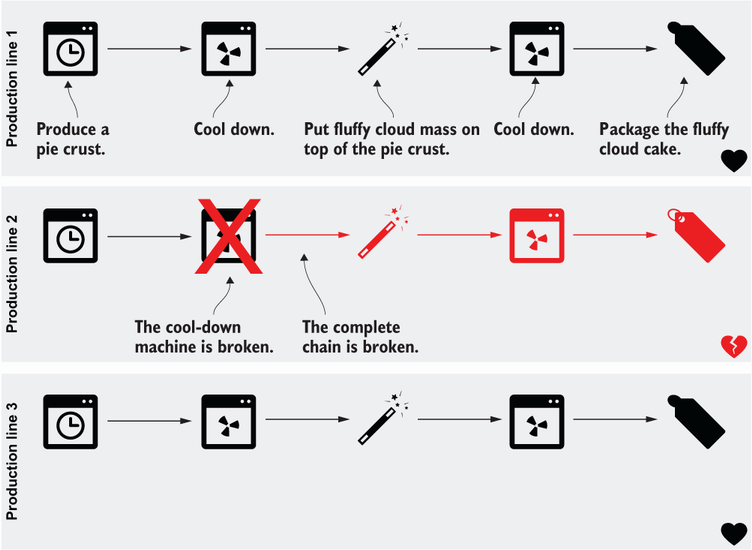
Compare a single production path with redundant paths to see how redundancy prevents one failed component from stopping the entire system. section 16.1.1



