A single point of failure is one component or condition whose outage, destruction, or compromise can disable an entire system. A lone server can become one when a power loss or disaster blocks access for everyone; a lone signing authority can become one when attackers target it. section 12.1.1 section 8.8
Common ways to remove or reduce the dependency include:
- Replicate databases across geographically separated backup servers and use high availability to continue service after a primary failure. section 12.1.1
- Distribute signing authority across multiple keys so an attacker must compromise several participants rather than one. section 8.8
- Split secrets into shares, while avoiding reconstruction in one place because that gathering point recreates the vulnerability. section 8.8
From one signer to many
A transaction that accepts only Alice’s signature makes Alice the critical target. Requiring signatures from n different public keys distributes trust: forging the transaction requires compromising all required signers. Signature aggregation can reduce the resulting transaction-size overhead. section 8.8
Figure 8.15 A recap of existing techniques to split the trust we have in one participant into several participants.
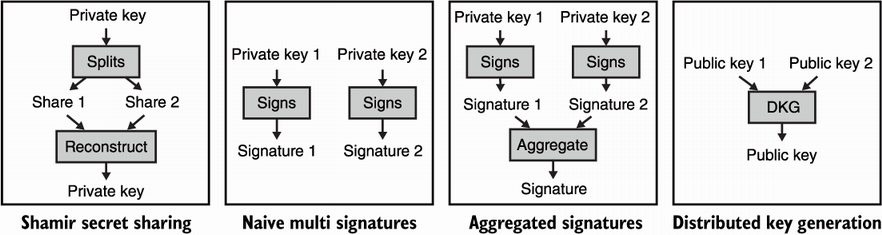
Survey the techniques used to split trust among several participants. section 8.8



