An SNMP agent is the SNMP software component running on each managed device. It interfaces with the NMS, receives Get and Set requests on UDP port 161, accesses the device MIB, and returns responses or sends Trap notifications to the manager on UDP port 162. section 6.1.2
The agent participates in these SNMP operations:
- Processes Get, GetNext, and GetBulk requests to retrieve MIB variables. section 6.4
- Processes Set requests to modify MIB variables or initiate actions such as reboots and configuration backups. section 6.4
- Sends Trap notifications when events such as interface failures occur. section 6.4
- Restricts read and write behavior through read-only or read-write community strings in SNMPv1 and SNMPv2c. section 6.3.1
Basic Cisco IOS agent configuration
R1(config)# snmp-server community password123 RO R1(config)# snmp-server community password456 RW R1(config)# snmp-server enable traps R1(config)# snmp-server host 192.168.1.10 version 2c password789 The RO string permits reads but rejects Set requests; the RW string permits both. The final commands enable traps and identify the NMS receiving SNMPv2c traps. section 6.3.1
Figure 6.4 The components of the NMS’s and managed devices’ SNMP entities. The NMS’s SNMP entity consists of the SNMP manager and SNMP application(s). The managed devices’ SNMP entities consist of the SNMP agent and the MIB.
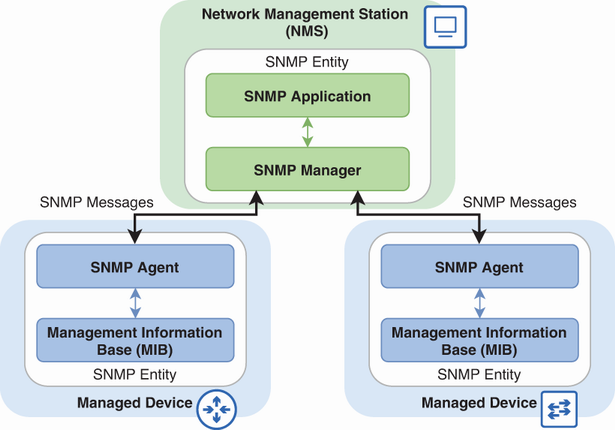
Use the component diagram to distinguish the SNMP agent and MIB on managed devices from the manager and applications on the NMS. section 6.1.2
