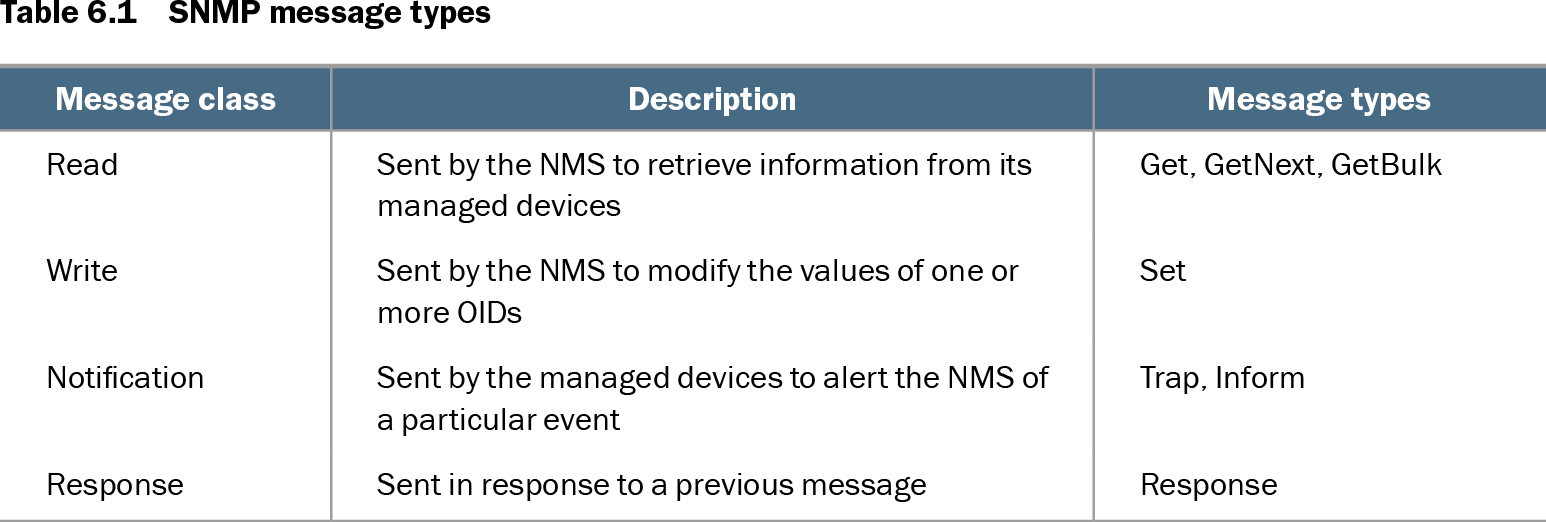
An SNMP message is exchanged between a network management system and a managed device to retrieve data, change OID values, report events, or acknowledge requests. section 6.2 section 6.4
Classify SNMP messages by their operational role:
- Read: Get, GetNext, and GetBulk retrieve OID values; GetNext discovers the next OID, while GetBulk retrieves ranges efficiently. section 6.2 section 6.4
- Write: Set modifies one or more OID values. section 6.2 section 6.4
- Notification: Trap reports events without acknowledgment or retransmission; Inform requires a Response and can be retransmitted. section 6.2 section 6.4
- Response: answers Get, GetNext, GetBulk, Set, and Inform messages. section 6.2 section 6.4
Table 6.1 SNMP message types (view table figure)
| Message class |
Description |
Message types |
|---|---|---|
| Read |
Sent by the NMS to retrieve information from its managed devices |
Get, GetNext, GetBulk |
| Write |
Sent by the NMS to modify the values of one or more OIDs |
Set |
| Notification |
Sent by the managed devices to alert the NMS of a particular event |
Trap, Inform |
| Response |
Sent in response to a previous message |
Response |
Compare SNMP message classes, directions, and included message types. section 6.2