A span is a timed record of one operation or component segment within a distributed trace. Spans show how a request unfolds across application components and external services. section 9.4
A trace for POST /ask contains spans for request handling, ChatClient, vector-store operations, RAG processing, and the model call. Parent spans can contain narrower operations. section 9.4
Inspect spans to understand what an application did:
- Select the /ask trace in Jaeger and inspect its span hierarchy. section 9.4
- Expand span tags to identify a vector-store query’s purpose, such as retrieving conversation history. section 9.4
- Compare multiple spans to explain why one question produced two Qdrant queries and two adds. section 9.4
Figure 9.11 Inspecting the tags for a Qdrant query span
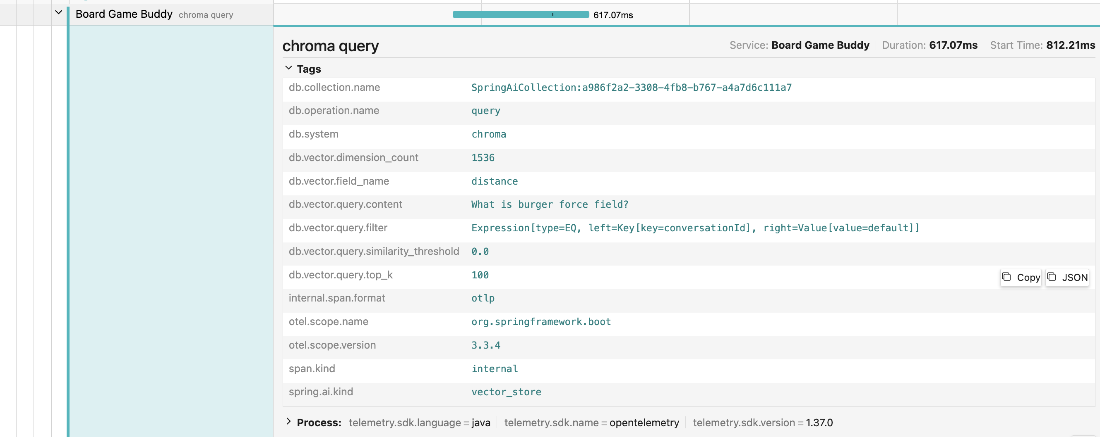
Inspecting the tags for a Qdrant query span demonstrates how span metadata reveals an operation’s purpose. section 9.4





