Statefulness means that an operation depends on or changes persistent application or external-system state. It makes duplicate evaluation requests risky because they can repeat writes, trigger workflows, or create user-visible side effects. section 4.3.3
Protect stateful systems during shadow-traffic evaluation by:
- Routing writes to isolated databases or preventing shadow requests from modifying shared state. section 4.3.3
- Using dry-run adapters, sandboxed APIs, read-only credentials, recorded responses, or mock outputs for external tools. section 4.3.3
- Intercepting emails and notifications, while preserving production security and data-retention controls. section 4.3.3
Figure 4.2 illustrates how shadow traffic adds additional load to the supporting infrastructure such as feature database layer, metadata services, caches and user context lookups. This is one of the primary risks of shadow traffic that's worth over communicating so that the machine learning or platform infrastructure teams aren’t surprised by an increase in requests as a result of the shadow traffic evaluation.
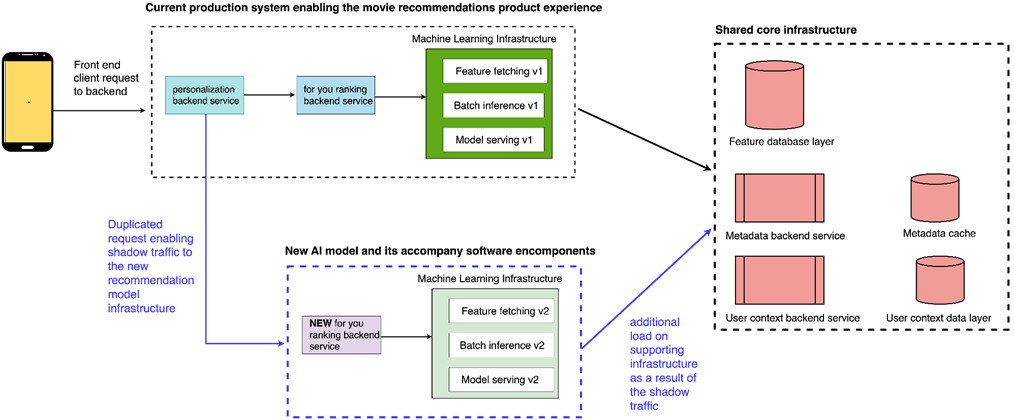
Shadow traffic can add load across feature databases, metadata services, caches, and user-context lookups, even when state changes are blocked. section 4.3.3














