Stateless Address Autoconfiguration (SLAAC) lets an IPv6 host generate its own address and learn network information, such as the default gateway, without a central address-assignment server. section 21.1.3
SLAAC uses NDP router discovery in this sequence:
- The host sends a Router Solicitation (RS) to the all-routers multicast address ff02::2. section 21.1.3
- A router returns, or periodically sends, a Router Advertisement (RA), typically to ff02::1. section 21.1.3
- The host combines the advertised prefix with a Modified EUI-64 interface identifier to form its IPv6 address. section 21.4
Cisco IOS configuration
On a Cisco router interface, configure ipv6 address autoconfig. The router sends an RS, receives an RA containing a prefix such as 2001:db8::/64, and generates its address automatically. Cisco IOS uses Modified EUI-64; some operating systems randomly generate the interface portion. section 21.1.3
Figure 21.3 R2 uses SLAAC to generate an IPv6 address. (1) Issue the ipv6 address autoconfig command. (2) R2 sends an RS message. (3) R1 responds with an RA message. (4) R2 combines the learned prefix with a Modified EUI-64 interface ID to make its IPv6 address.
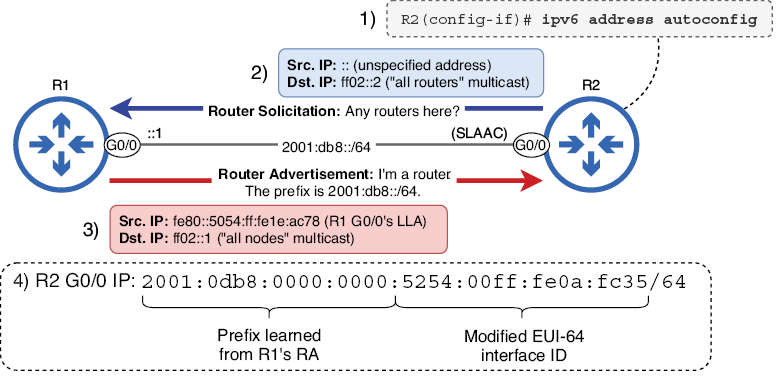
Follow the four-message-and-generation sequence from interface configuration through RS, RA, and the completed IPv6 address. section 21.1.3
