Static analysis examines a policy set without executing it against sample requests. It asks whether the policy structure can produce unintended access decisions before deployment: for example, whether a rule is unreachable, two rules conflict, or no rule covers an action or resource. In authorization, this provides a safety net for changes that look correct in a few tests but fail in untested cases. section 10.3 section 10.0
Testing and static analysis answer different questions. Request-driven tests confirm expected allow or deny results for realistic principals, actions, resources, and entity relationships. Static analysis instead examines policies across possible schema-valid inputs, finding structural problems that example-based tests may miss. Use both: tests protect known scenarios and regressions; analysis checks broader soundness and completeness. section 10.3 section 10.5
Cedar Analysis can identify policy-set issues before production:
- Conflicts, where one policy grants access while another denies it under the same conditions. section 10.3
- Redundancy, where overlapping policies seldom take effect. section 10.3
- Gaps, where no policy addresses an action or resource and an unexpected implicit denial can result. section 10.3
- Contradictions, unreachable rules, coverage, invariant, and equivalence concerns, including whether a refactoring preserved policy behavior. section 7.4.6
This analysis is enabled by a constrained policy design: limited types, pure expressions, strong typing, simple data access, and a minimal operator set. Cedar blocks file-system access, network calls, and other side effects; it also omits constructs such as loops and regular expressions. Those limits make policy behavior more predictable, auditable, and amenable to symbolic, SMT-based checks with formal guarantees. section 7.4.6 section 7.6
Guarding a policy change in CI
A pull request can run syntax and schema validation, static analysis, and unit tests before merging. Analysis flags structural errors while the policy change is small and reviewable; passing changes are bundled, signed, and published to the policy store. Human reviewers still assess whether the rule expresses the intended business requirement, compliance officers check regulatory alignment, and administrators check consistency with existing policies. section 10.2.4 section 14.2.2
Figure 10.6 Continuous integration for policies. Bob’s pull request triggers validation, analysis, and testing. After the checks pass, his changes are merged, bundled into a signed package, and published to a policy store, where the authorizer uses them to evaluate requests at runtime.
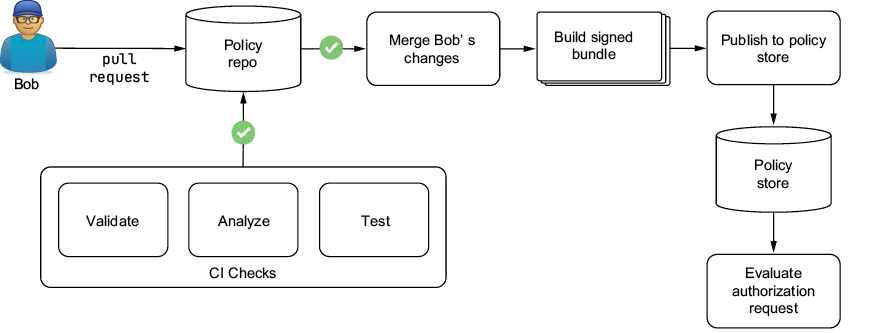
The pipeline diagram shows where analysis fits: after a pull request and before merging, packaging, publication, and runtime authorization. section 10.2.4
Operationally, static analysis supports policy as code. Run it in continuous integration alongside schema validation, reviews, versioning, and tests; block deployment when checks fail. This turns authorization changes from scattered application logic into reviewed, repeatable, auditable artifacts and reduces the chance that a policy refactor creates accidental access. section 10.2.4 section 7.1





