Statistical modeling supports practical supply-chain questions: What drives demand, why did a forecast look strange, and how might a promotion change future demand? It represents relationships between historical demand, demand drivers, and predicted outcomes in forms that people can inspect and interpret. section 14.5 section 15.1.2
Common uses differ in the relationships they expose:
- Time-series models reveal demand level, trend, and seasonality, making unusual forecasts easier to investigate. section 14.5
- Predictive models use demand drivers such as pricing, promotions, or weather to estimate effects and plan scenarios. section 14.5
- Compared with machine learning, statistical models offer greater interpretability but handle less complexity and may deliver less accuracy. section 14.5 section 15.1.2
Promotion planning
A planner can ask whether a promotion will raise future demand by 15%, then inspect the promotion effect alongside level, trend, and seasonality. If the forecast is unexpected, those components and drivers indicate where to investigate. section 14.5
Figure 15.3 Promo uplift and scenarios
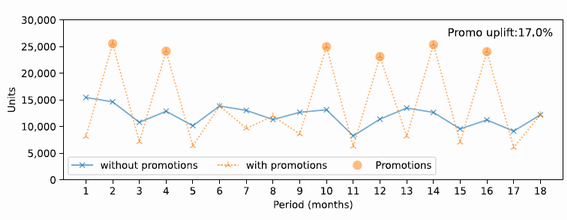
Use the promotion-uplift and scenario figure to connect demand-driver effects with planning decisions. section 15.1.2



