Strategic planning turns business opportunities and challenges into a prioritized collection of deliverable software features. It identifies business goals, explores possible value, and produces high-level features for the product backlog before refinement and implementation. section 4.1 section 4.1.1
Make strategic planning a collaborative, recurring activity:
- Bring executives, stakeholders, domain experts, and delivery-team members into the same planning conversation. section 4.1.3
- Use techniques such as Impact Mapping and Pirate Canvases to connect business value with possible features while exposing assumptions and risks. section 4.1.1
- Prioritize what to deliver rather than specifying every detail too early; refine features later as understanding improves. section 4.1 section 4.1.2
- Revisit priorities as market conditions, lessons from released features, requirements, and assumptions change. section 4.1.2
Choosing a planning cadence
A team may coordinate strategic planning in two- to three-month cycles, aligning with program increment planning in SAFe. Another organization may use weekly meetings with team delegates and senior stakeholders, making smaller adjustments as new information appears. section 4.1.2
Contrast a handoff model—where executives define requirements and development teams receive finished specifications—with collaborative planning. Early participation gives builders practical business context, surfaces feasibility concerns, encourages better solution ideas, and reduces misunderstandings and incorrect assumptions. section 4.1.3
Figure 4.1 The Speculate phase helps teams, and organizations as a whole, identify and prioritize the deliverables that matter most.
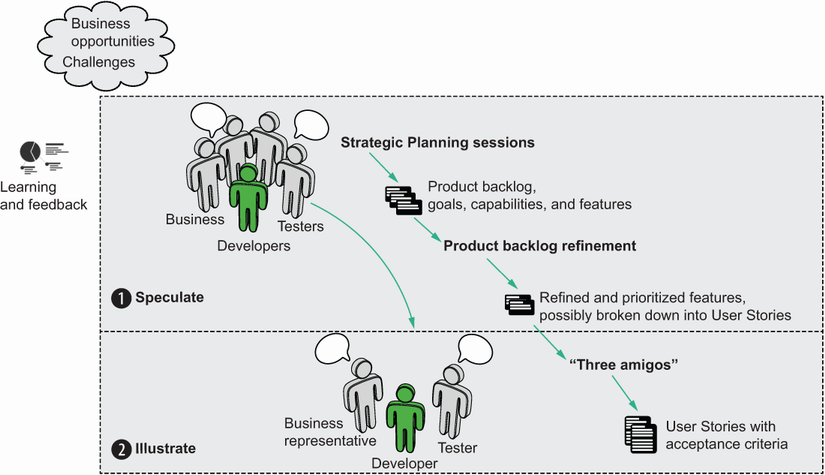
Use the phase diagram to trace how strategic planning identifies and prioritizes deliverables before teams refine and implement them. section 4.1


