A stream-aligned team is a small, long-lived team responsible for an end-to-end stream of work, from requirements to production software. It does most of the work while minimizing hand-offs between teams. section 1.1.3
Other team types support stream-aligned teams, which interact with them in three main ways:
- Platform teams provide tools, infrastructure, or libraries; enabling teams help build capabilities; complicated subsystem teams develop modules requiring deep expertise. section 1.1.3
- Teams primarily consume another team's work as a service, and may also collaborate to discover solutions or facilitate improvements. section 1.1.3
- Autonomy also depends on loose design-time coupling, so a team can change its part without regularly requiring changes from other teams. section 1.2.1
Orders and Consumers
The Orders team owns Order Management, which uses Consumers' Consumer Management module. With loose design-time coupling, Orders can change its module without regularly coordinating with Consumers; tight coupling would require frequent coordination. section 1.2.1
Figure 1.4 The four types of Team Topologies teams and the three ways that they interact. Stream aligned teams are responsible for turning requirements into code running in production. They are supported by platform, enabling, and complicated subsystem teams. Teams primarily interact via the X-aaS interaction style: consuming the work of another team "as a service". But sometimes they work together to discover new things or help each other improve their ways of working.
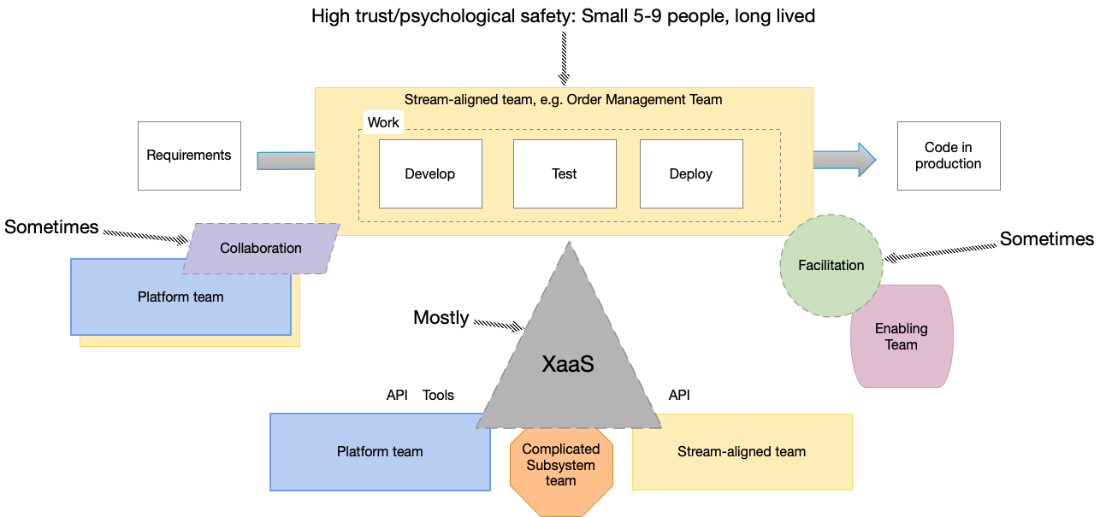
See how stream-aligned teams relate to supporting team types and interaction styles. section 1.1.3


