A stride is the number of pixels a convolutional filter jumps each time it moves across an input. A stride of 1 checks every neighboring position; a stride of 2 skips one pixel between positions. section 12.17
Halving a feature map
A downsampling layer uses a 4×4 filter with stride 2 on an 8×8 feature map. The filter jumps two pixels at a time, producing a 4×4 output and a more compressed summary of the image. Padding adds a border of blank values to help preserve edge information. section 12.17
Figure 12.35 How filters scan an image with padding
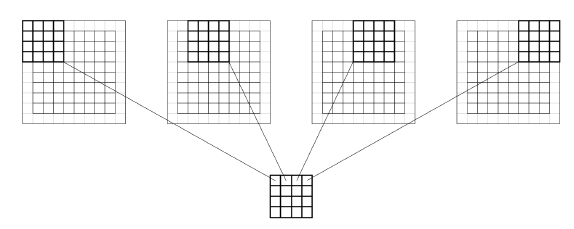
Trace how a padded filter scans an image and how stride changes the filter’s successive positions. section 12.17
def apply_padding_3d(tensor, padding): #A
    return np.pad(tensor, ((0, 0), (padding, padding),
    ➥(padding, padding)), mode='constant', constant_values=0)

def downsample_convolution(feature_maps_in, num_output_channels):
    input_channels = feature_maps_in.shape[0]
    input_height = feature_maps_in.shape[1]
    filter_size = 4
    stride = 2
    padding = 1

    padded_maps = apply_padding_3d(feature_maps_in, padding)

    output_height = (input_height + 2 * padding - filter_size)
    ➥// stride + 1 #B
    output_width = output_height

    filters = np.random.randn(num_output_channels,
    ➥input_channels, filter_size, filter_size) * 0.01 #C
    biases = np.random.randn(num_output_channels) * 0.01

    feature_maps_out = []

    for k in range(num_output_channels):
        current_bias = biases[k]
        output_map = np.zeros((output_height, output_width))

        for i in range(output_height):
            for j in range(output_width):

                accumulation_sum = 0

                for c in range(input_channels):

                    current_filter = filters[k, c]

                    r_start, c_start = i * stride, j * stride
                    region = padded_maps[c, r_start : r_start +
                    ➥filter_size, c_start : c_start + filter_size] #D

                    accumulation_sum += np.sum(region * current_filter)

                output_map[i, j] =
                ➥accumulation_sum + current_bias #E

        feature_maps_out.append(output_map)

    h2 = np.stack(feature_maps_out, axis=0)

    return h2
Inspect a NumPy-style downsampling convolution where stride, padding, filter size, and output dimensions are configured explicitly. section 12.17







