Syntax concerns the formal structure of symbols and the rules for manipulating them. In language, it links words into patterns that support expression and reasoning. Syntax differs from semantics: an expression can have a recognizable structure without conveying a coherent meaning. section 1.5.4 section 2.1.1 section 2.6.1
A grammatical but nonsensical sentence
“Colorless green ideas sleep furiously” follows grammatical patterns but does not describe a coherent situation. Its form alone does not guarantee meaning. section 2.6.1
The Chinese Room thought experiment uses rule-governed symbol manipulation to question whether computation can produce understanding. Searle argued that following rules for symbols is not enough to grasp their meaning. Critics replied that understanding might belong to the system as a whole, rather than to the person following the rules. section 1.5.4
Figure 1.8 The Chinese Room thought experiment. A person who does not understand Chinese sits inside a room with a rulebook written in English that explains how to manipulate Chinese symbols. By following these instructions, the person produces correct responses to messages written in Chinese. To an external observer the replies appear meaningful, even though no one inside the room understands the language.
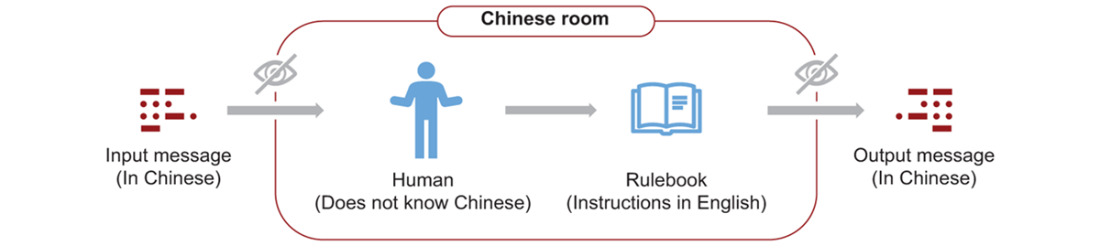
The figure illustrates how rule-following can produce fluent replies without the person manipulating the symbols understanding them. section 1.5.4
Large language models complicate the distinction. They learn statistical patterns of word use, and their representations can capture relationships among terms used in similar contexts. This is a relational form of semantics: it reflects connections within language without necessarily grounding those connections in direct experience of the world. section 1.5.6 section 1.7
Fluent output is therefore not, by itself, proof of understanding. Modern systems can be difficult to inspect, so their observable performance may not settle how their responses arise or whether understanding is present. Language models also face a practical tension: they must generalize across many possible expressions without losing meaningful distinctions. section 1.5.5 section 2.6.1



