liveBook · Manning

Task

As explained in Rust in Action: Systems programming concepts and techniques

A task is an abstract unit of work whose meaning may range from a thread to a function call or a running program.

A task is an abstract unit of work whose meaning changes with the level of discussion. It can refer to a process thread, a function call within a thread, or a running program managed by an operating system. section 10.5

The term commonly shifts between these contexts:

  • Within a process, a task is one of its threads. section 10.5
  • Within a thread, a task may be a function call. section 10.5
  • At the operating-system level, a task may be a running program. section 10.5

Task virtualization also involves isolation. Isolated tasks cannot freely interfere with one another, access one another’s data, or cause failures to cascade, although stronger isolation brings greater overhead and limits communication. section 10.5

Figure 10.5 Trade-offs relating to different forms of task isolation in computing. In general terms, increasing the isolation level increases the overhead.
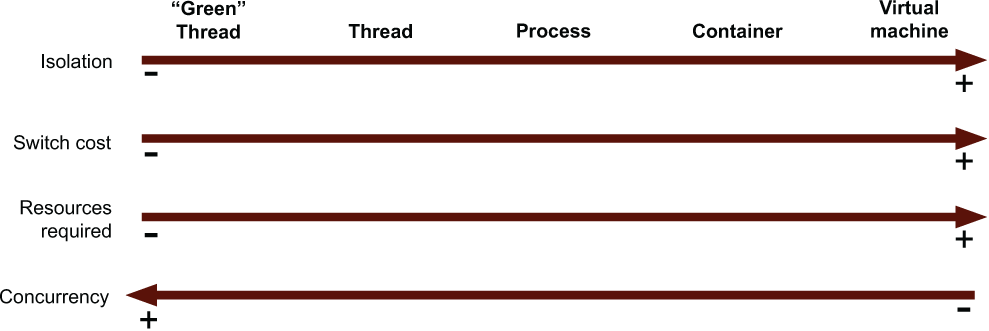
Compare forms of task isolation and observe the general trade-off between increasing isolation and increasing overhead. section 10.5


How Rust in Action: Systems programming concepts and techniques covers it

How deep it goes
Defines the term across abstraction levels and relates it to isolation, but stops short of implementation details.
Examples
Uses process threads, function calls, running programs, blocked console output, and virtual machines as concrete cases.
What you can do after
Evaluate task models by comparing their meanings, isolation properties, interference risks, and runtime overhead.
How it connects
Connects tasks with concurrency, processes, threads, function calls, operating systems, and virtual machines.

Also explained in

Compare how 10 books explain task →

Related concepts

This explainer was generated by Manning's knowledge graph from the text of Rust in Action: Systems programming concepts and techniques. The section links point to the parts of the book it draws on.







