Team Topologies is a set of principles and practices for designing organizations to enable fast software delivery. It provides an organizational structure alongside DevOps and an architecture that supports both. section 1.5 section 1.1.3
The model identifies four team types and several ways they interact:
- Stream-aligned teams turn requirements into code running in production. section 1.1.3
- Platform, enabling, and complicated-subsystem teams support stream-aligned teams. section 1.1.3
- Teams mainly consume other teams’ work as a service; they may also collaborate to discover solutions or help each other improve. section 1.1.3
Figure 1.4 The four types of Team Topologies teams and the three ways that they interact. Stream aligned teams are responsible for turning requirements into code running in production. They are supported by platform, enabling, and complicated subsystem teams. Teams primarily interact via the X-aaS interaction style: consuming the work of another team "as a service". But sometimes they work together to discover new things or help each other improve their ways of working.
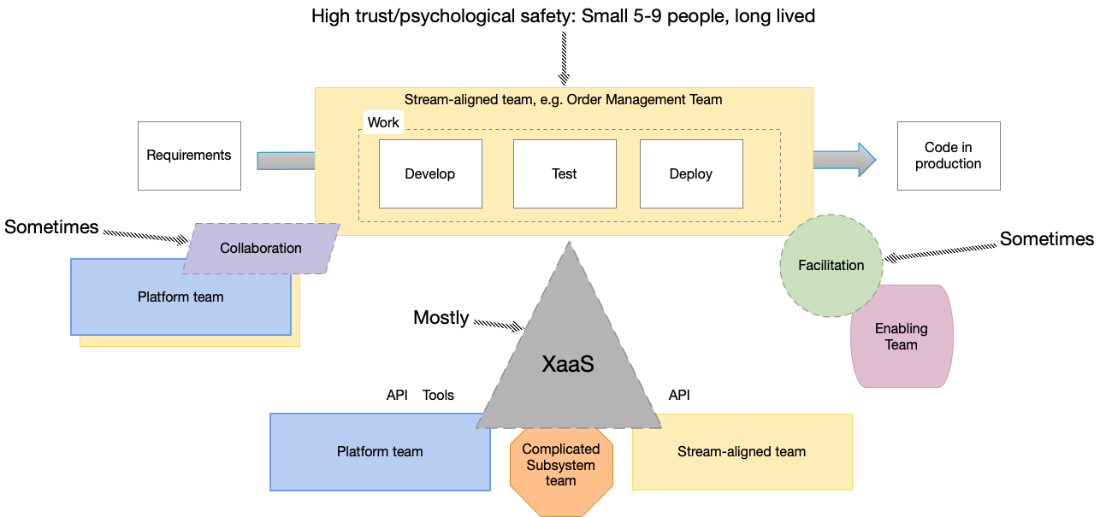
Use the diagram to compare the four team types and their interaction patterns. section 1.1.3
Do not treat a team-structure change as a substitute for DevOps or enabling architecture. When delivery is slow, first check whether these organizational and process changes, modularization, and an automated deployment pipeline are sufficient before migrating to microservices. section 1.4.2 section 2.3


