Technical debt is the future cost of maintaining or changing a system when expedient implementation choices create structural limitations or rework. In AI organizations, it often grows from uncoordinated progress: individually sensible model, storage, and architecture decisions become a fragile ecosystem of one-off solutions and hidden assumptions. section 1.1.4 section 1.2.2
AI technical debt accumulates when:
- Effective prompts, safety configurations, and other solutions remain trapped inside individual applications instead of becoming reusable capabilities. section 1.1.4
- Teams repeat experiments and rebuild infrastructure for unstructured data, multi-step reasoning, external tools, and real-time generation. section 1.2.2
- Every change must navigate disconnected services, hidden assumptions, and infrastructure assembled independently by different teams. section 1.1.4
From chatbot prototype to production liability
A developer can demonstrate a promising chatbot in days, but real users expose the need for performance monitoring, cost controls, safety guardrails, and operational infrastructure. Without shared platform services, the prototype becomes a months-long engineering project that other teams cannot reuse. section 1.0 section 1.2.2
Figure 1.2 The GenAI Infrastructure Explosion. The model API call now represents just 2% of total system complexity—even less than in traditional ML. Modern GenAI applications require vastly expanded infrastructure: knowledge management systems, safety and compliance layers, session management for conversations, tool integration platforms, advanced observability, and multi-provider model orchestration. This architectural shift explains why simple prototypes become complex production systems.
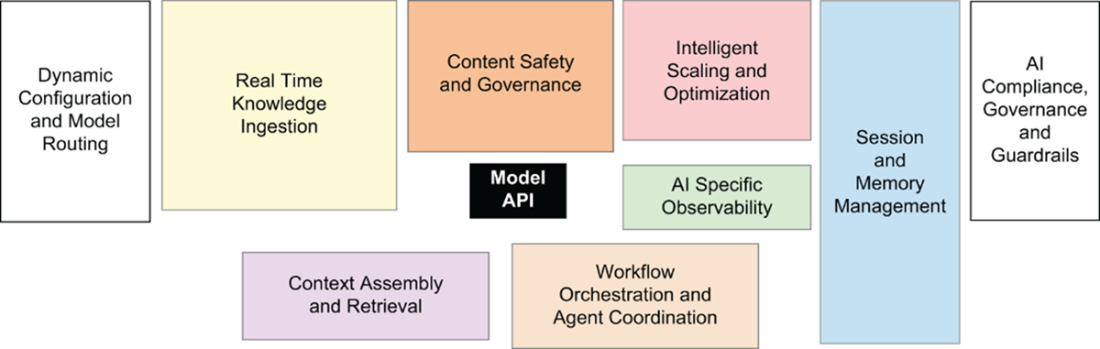
Use the infrastructure-explosion figure to compare the small model API call with the broader production system: knowledge management, safety and compliance, session management, tool integration, observability, and model orchestration. section 1.2.2