Repeated manual checking is slow, easy to forget, and hard to repeat after every change. A test automation framework provides the shared machinery for writing tests, running them automatically, and reviewing what happened. For unit and integration tests, it replaces one-off scripts with known APIs and repeatable feedback. section 1.0
A framework is not the test itself. You can automate a test with plain JavaScript: call the system under test, compare the actual result with the expected result, and print an error when they differ. But once there are many tests, that homemade approach needs its own error formatting, assertion helpers, exception handling, and way to continue after failures. section 1.6
From a one-off check to framework responsibilities
A small custom test can call sum('1,2'), compare its result with 3, and report a failure. A reusable check function can wrap each test, catch exceptions, and print a pass or fail message. A testing framework normally supplies this structure and assertion behavior, so developers can focus on describing expected behavior rather than rebuilding the test harness. section 1.6
A test automation framework makes several routine testing jobs easier:
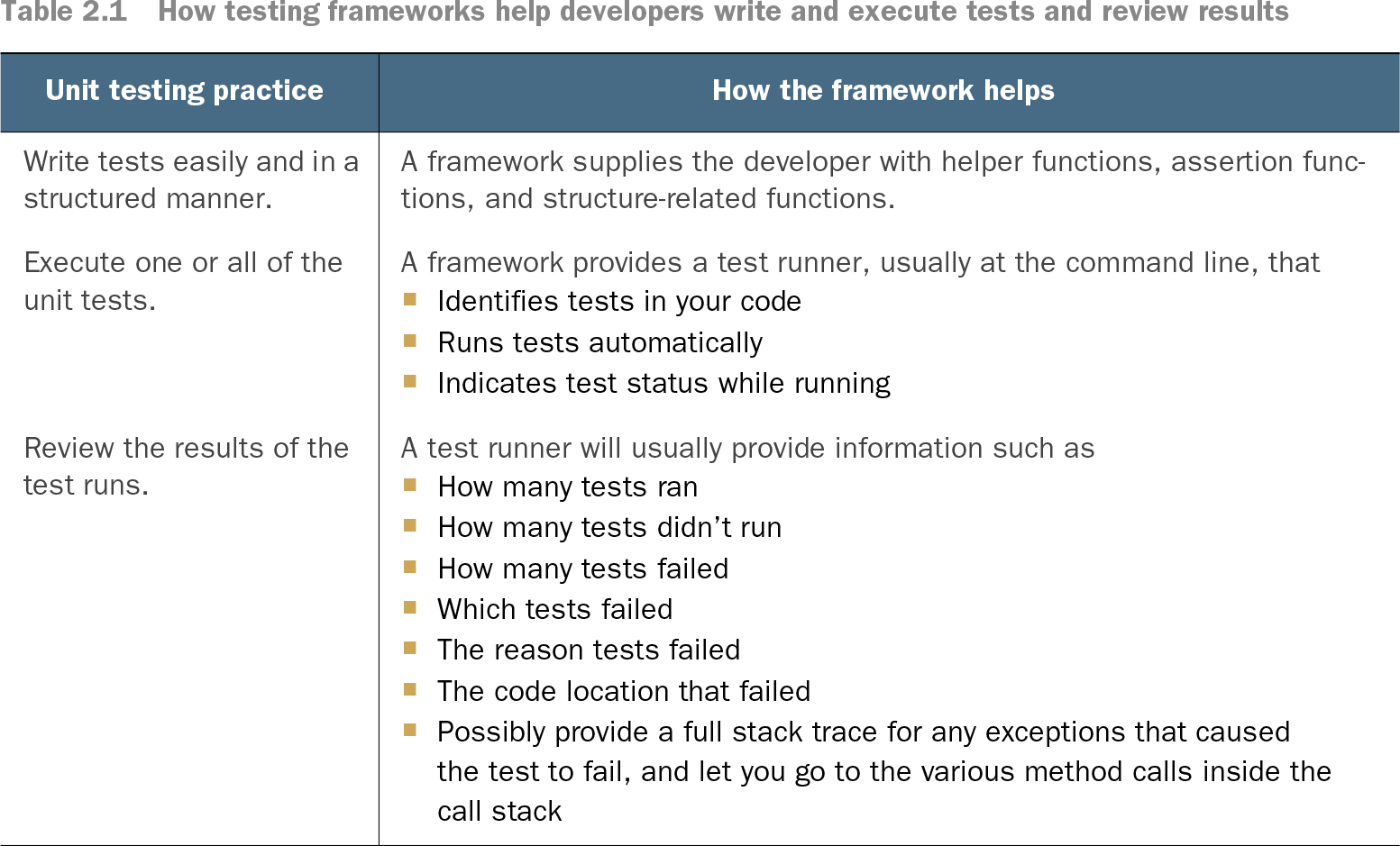
- Give tests a recognizable structure through helper, assertion, and structure-related functions. section 2.3
- Find and run one or all tests automatically through a test runner, often from the command line. section 2.3
- Report run status, failed tests, failure reasons, code locations, and possibly exception stack traces. section 2.3
- Make repeated test writing and execution quick enough to support frequent checking during development. section 2.3
The practical advantage is not merely convenience. A mature, widely used framework is less likely to contain unnoticed framework bugs than a hand-rolled replacement. It also lowers the effort of adding tests for behavior that seems less critical, where small but meaningful bugs can otherwise be skipped when time is short. Framework reports can additionally give a team a shared signal that a task is passing. section 2.3
A framework does not remove the need to decide what to test or what result is correct. Its value is in standardizing the mechanical work: test definitions use framework libraries, a runner executes them in an IDE or at the command line, and a reporter exposes results to a developer or automated build process. section 2.3
Table 2.1 How testing frameworks help developers write and execute tests and review results (view table figure)
| A framework supplies the developer with helper functions, assertion functions, and structure-related functions. |
|
| A framework provides a test runner, usually at the command line, that |
|
Use this reference to connect everyday test work—writing, executing, and reviewing—to the framework features that support each step. section 2.3