Threat detection identifies suspicious activity early enough for a security team to investigate and respond. Advanced detection combines real-time monitoring, anomaly detection, predictive analytics, and AI-driven models to find threats that may not match known attack signatures. Its value depends not just on finding alerts, but on finding credible threats quickly enough to reduce harm. section 10.3
A continuous detection program connects monitoring to action:
- Define the systems in scope and the risks and metrics that matter. Collect network traffic, logs, and application activity through sensors on endpoints, servers, and network devices. section 8.1
- Analyze the collected data for suspicious patterns or anomalies. Tools such as Wazuh can monitor logs, traffic, and file integrity, then generate alerts. section 8.1 section 8.2
- Investigate and document detections, including their time, source, affected systems, and initial severity. Predefined responses may alert the team, isolate an affected system, or block a malicious IP address. section 9.4 section 8.1
Measure whether the program improves decisions, not merely whether it produces more alerts. Track time to detect and respond alongside detection accuracy and false alerts. False acceptance and false rejection rates can help tune the process and limit unnecessary investigation. Pairing detection with rapid containment can reduce the time an attacker remains active and limit an incident’s effects. section 9.4 section 9.1
Translate a detection investment into a decision
A healthcare organization invested $500,000 in AI-driven detection to protect patient data and keep services running. Its executive presentation compared incident response time before and after the investment—24 hours versus 4 hours—and reported a 100% HIPAA audit pass rate and no successful ransomware attacks in the past year. It also presented $2.5 million in estimated breach-prevention savings and $500,000 in downtime savings. For leadership, distinguish measured operational changes from estimated losses avoided; both inform the investment case, but they are not the same kind of evidence. section 4.3.4
Figure 10.3 The left side shows the effectiveness of the AI dashboard, presenting daily false positive rates, true positive detection rates, and the average incident response time. On the right is its effectiveness after implementing an AI-driven solution.
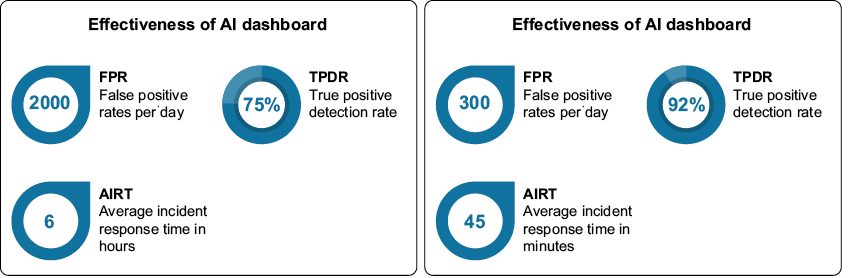
A before-and-after dashboard puts daily false positives, true-positive detection, and average response time together, making it easier to judge whether faster detection also reduces analysts’ workload. section 10.4.3
AI is one option within this workflow, not a substitute for checking results. Anomaly detection can flag behavior outside established patterns; random forests and support vector machines can learn from past examples such as suspicious emails. Set accuracy and response targets, review false positives, and prioritize incidents by risk so analysts can concentrate on consequential threats. section 10.3 section 12.3 section 10.4.3

