A threat model turns security concerns into explicit, checkable requirements: identify what must never happen, then derive verification from those threats. Without it, an injectable query can pass functional, contract, property, and performance checks. section 1.5
Use a threat model as an engineering control rather than an after-the-fact review:
- State security conditions during specification, such as required authentication, untrusted inputs, and replay-safe operations. section 1.5
- Keep security as a separate verification gate so slow general test suites do not silently drop it. section 1.5
- Derive adversarial tests rather than relying on model-generated happy-path unit tests; combine them with scanning and stack-tuned static analysis. section 1.5 section 1.6
A missing attacker test
A feature can have tests and still omit the vulnerability an attacker would exploit. An injectable query may satisfy functional correctness, contracts, properties, and performance checks; a threat-derived test makes that attack path visible. section 1.5 section 1.6
Figure 1.3 Each phase produces concrete, verifiable artifacts that all feed one executable specification, which the CI/CD pipeline enforces.
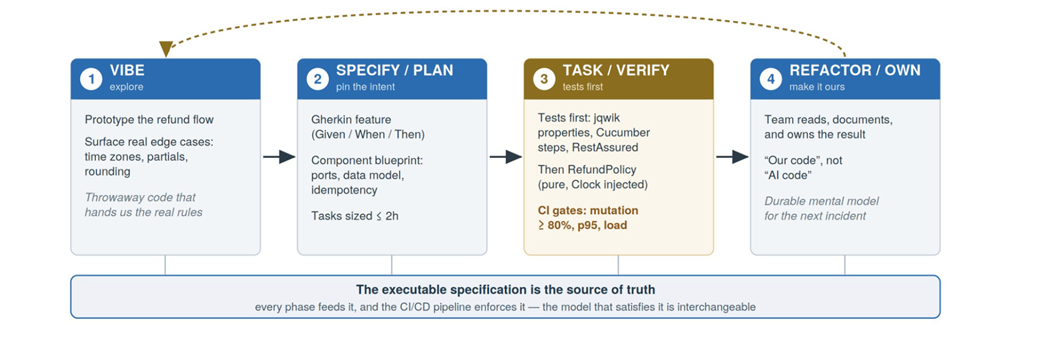
Use the executable-specification pipeline to place threat requirements alongside contracts, properties, performance gates, and other verifiable artifacts. section 1.5










