A rate limit restricts requests or database operations within an interval. Application throttling reduces demand when traffic threatens database performance, helping the system remain available. section 11.3.1
Use rate limits to manage database pressure:
- Throttle upstream application traffic when a hot partition or overloaded cluster needs time to recover. section 11.3.1 section 11.4
- Estimate capacity with cassandra-stress, then tune limits against the traffic a table can tolerate. section 11.3.1 section 11.4
- Treat ScyllaDB per-partition limits as approximate because replication and internal implementation details can distort traffic counts. section 11.3.1
Limit traffic to a reviews table
ScyllaDB can configure separate read and write ceilings for each partition: ALTER TABLE reviews.articles WITH per_partition_rate_limit = { 'max_reads_per_second': 10000, 'max_writes_per_second': 100 }; Because enforcement is not precise, configure substantially higher values than the desired effective limits. section 11.3.1
Figure 11.8 When Scylla gets more queries to a partition than it can handle, latency on the shard and node increases.
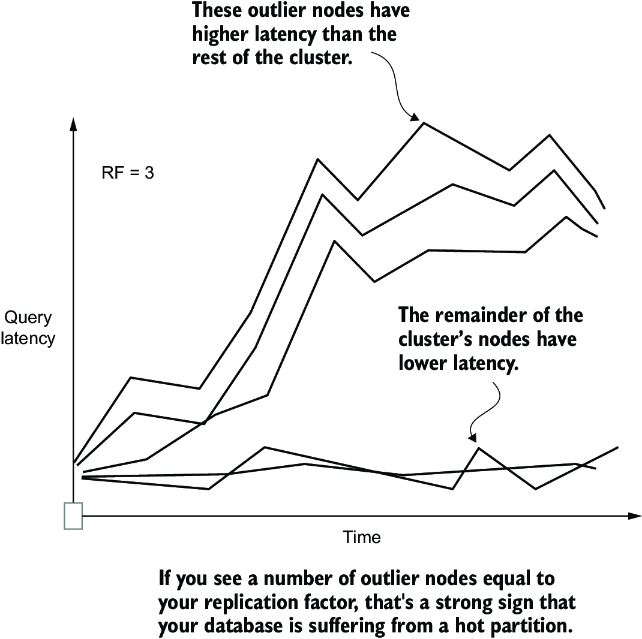
Shows how excessive requests to one partition increase shard and node latency. section 11.3.1













