A timestep is a discrete stage in a diffusion process. It identifies the noise level applied while transforming clean data into random noise, or while reversing that transformation through denoising. section 1.3.1
A timestep gives the diffusion process an ordered position:
- At timestep 0, the image is clean. section 1.3.1
- During forward diffusion, each successive timestep adds a controlled amount of noise; by timestep T, commonly 1,000, the image becomes approximately pure random noise. section 5.1.1
- During reverse diffusion, denoising proceeds from timestep T back toward timestep 0. section 1.3.1
The timestep determines how much noise is mixed into an image. With a reparameterized formulation, an image can be sampled directly at an arbitrary timestep t rather than generating every earlier noisy image. section 5.1.1
A denoising U-Net receives both a noisy image and its timestep, predicts the injected noise, and learns across randomly selected timesteps ranging from 1 through 1,000. section 5.3.1
Visualizing timestep progression
A DDIM scheduler can add noise at timesteps 0, 200, 400, 600, 800, and 1,000, then display the resulting images. The sequence makes the increasing noise level visible and supports a 4 × 5 grid exercise using timesteps 0, 250, 500, 750, and 1,000. section 7.2.2
Figure 1.6 In the forward diffusion process, we start with a clean image from the training set, x0, and add noise ε0 to it to form a noisy image x1, which is a weighted sum of x0 and ε0. We repeat this process for 1,000 time steps until the image x1,000 becomes random noise.
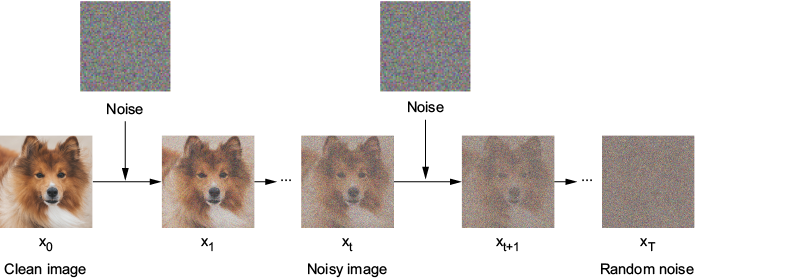
Use the diffusion diagram to trace how a clean image becomes random noise across ordered timesteps. section 1.3.1




