liveBook · Manning

Timestep

As explained in Natural Language Processing in Action, Second Edition

A time step is one ordered position in a sequential computation, corresponding here to a token position in text.

A timestep is one ordered position in sequential computation. For text, the recurrent network processes a different token at each position while reusing the same weights. section 8.3

During training, the error travels backward through these positions one token at a time. Each timestep contributes gradients that help adjust the shared weights. section 8.3

Token-by-token processing

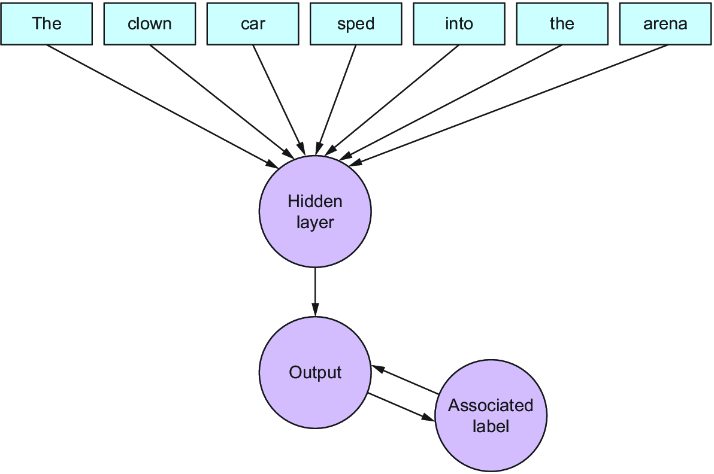
For a text sequence, timestep 1 processes the first token, timestep 2 processes the next, and so on. The same neural network is reused at every position. section 8.3

Figure 8.10 Data fed into a recurrent network
figure

Inspect the recurrent-network input layout to connect token positions with ordered timesteps. section 8.3


How Natural Language Processing in Action, Second Edition covers it

How deep it goes
Explains shared weights and serial backpropagation across tokens, without detailing tensor shapes or implementation code.
Examples
Uses text tokens, an unrolled recurrent network, and token-by-token gradient propagation as concrete illustrations.
What it assumes
Assumes familiarity with tokens and neural-network weights while grounding timesteps in recurrent processing.
What you can do after
Understand how recurrent networks reuse weights and propagate error across ordered token positions.
How it connects
Connects timesteps to tokens, recurrent neural networks, shared weights, and backpropagation through time.

Also explained in

Compare how 5 books explain timestep →

Related concepts

This explainer was generated by Manning's knowledge graph from the text of Natural Language Processing in Action, Second Edition. The section links point to the parts of the book it draws on.

