A timestep is one position in diffusion’s gradual journey between a clear image and random noise. Each position represents a particular noise level and guides the model’s next adjustment. section 12.2 section 12.9
Think of timesteps as snapshots in a controlled transformation:
- Early denoising timesteps handle images close to pure static and make larger, more aggressive corrections. section 12.2 section 12.25
- Later timesteps make smaller corrections, refining recognizable structures such as trunks, branches, and leaf texture. section 12.2 section 12.25
- The noise schedule assigns each timestep its noise amount; beta controls the added noise, alpha preserves signal, and alpha-bar tracks cumulative remaining signal. section 12.28 section 12.9
From static to a tree
Starting from random noise at a high timestep, the model repeatedly predicts noise and subtracts an amount determined by the schedule. Across many descending timesteps, a vague silhouette becomes a recognizable tree and finally a crisp image. section 12.2 section 12.25
Figure 12.17 Calculations for timestep embeddings
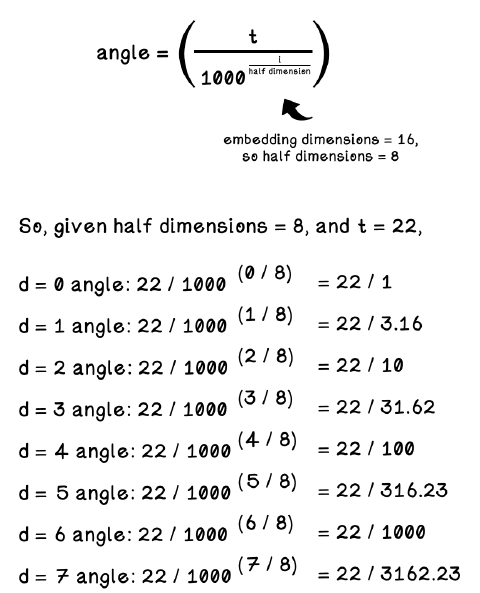
Use the timestep-embedding calculations to see how an integer such as t = 22 becomes a vector that communicates noise level to the model. section 12.10
A model receives the current noisy image, timestep, and often a text-prompt embedding. A sinusoidal timestep embedding turns the integer into a continuous vector so denoising strength can change with the noise level. section 12.10 section 12.25




